Walk · Colonialism · on foot
From the Padrão to the quay
The empire the Estado Novo staged in Belém, the people from the colonies put on display in 1940, the embarkations for the war and the return of 1975
- Distance
- 4.5 km
- Duration
- 2 h 10 min
- Stops
- 8
- Difficulty:
- Easy
Stops
Map of the walk “From the Padrão to the quay”, with 8 numbered stops. The list of stops follows the map.
The stops
Stop 1: : 1940, 1960, 1975 — the myth and the cratesToday: A monument with a viewpoint, an auditorium and exhibition rooms
Avenida de Brasília, 1400-038 Lisboa
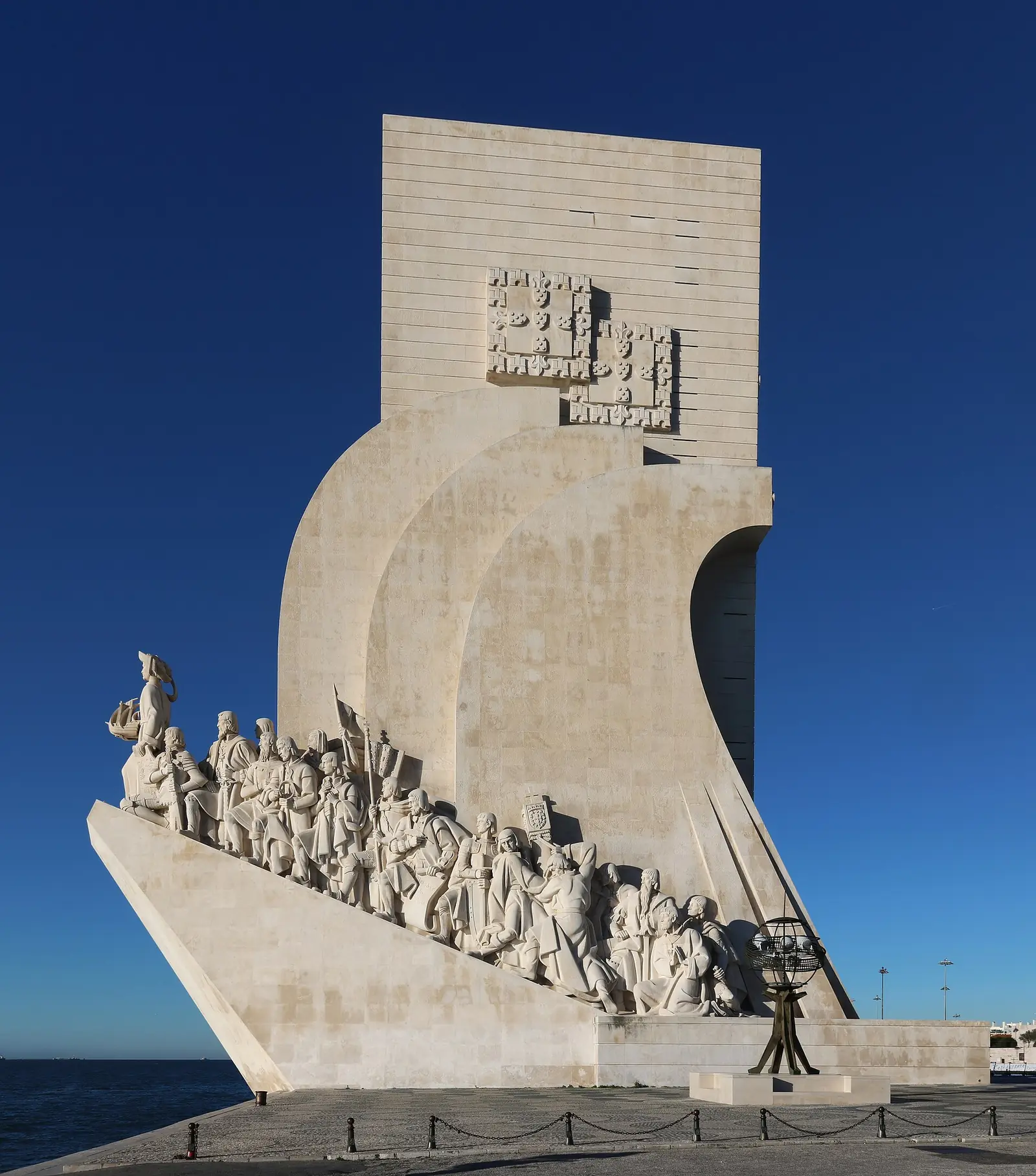
The Padrão dos Descobrimentos (Monument to the Discoveries), the stone one, inaugurated in 1960, on a January morning in 2022. Ingo Mehling, CC BY-SA 4.0 Let us begin with the myth. The Padrão was put up in 1940, in materials that were not meant to last, for the Exhibition of the Portuguese World, and rebuilt in stone in 1960, five hundred years after the death of Prince Henry the Navigator (the infante D. Henrique).5 At the prow stand the prince and 32 figures of the expansion; only one of them is a woman, Queen Philippa of Lancaster (D. Filipa de Lencastre) — his mother.6 The “Discoveries”, the name given to the voyages of the 15th and 16th centuries, served Salazarism to legitimise the regime and the empire.2
The compass rose at its feet was a gift from South Africa in 19607 — a gift made, writes the historian José Pedro Monteiro, “at a critical moment for the projects of white supremacy on the African continent”.8 Months later, the war in Angola began. In mid-1975, next to this Padrão, the crates of those arriving from the colonies that were becoming independent piled up.910
A kilometre to the west, by Bom Sucesso Fort, stands the Monument to the Overseas Combatants (Monumento aos Combatentes do Ultramar), inaugurated on 15 January 1994; plaques with the names of some ten thousand soldiers killed in the colonial war, including African soldiers of the Portuguese Armed Forces, were later added to the walls of the fort. By the end of the war, soldiers recruited in the colonies made up almost half of the troops.11
To stop 2430 m · 6 min on foot
Stop 2: : 1940 — the empire on displayToday: A public garden, with the Fonte Monumental in the centre
Praça do Império, 1400-206 Lisboa
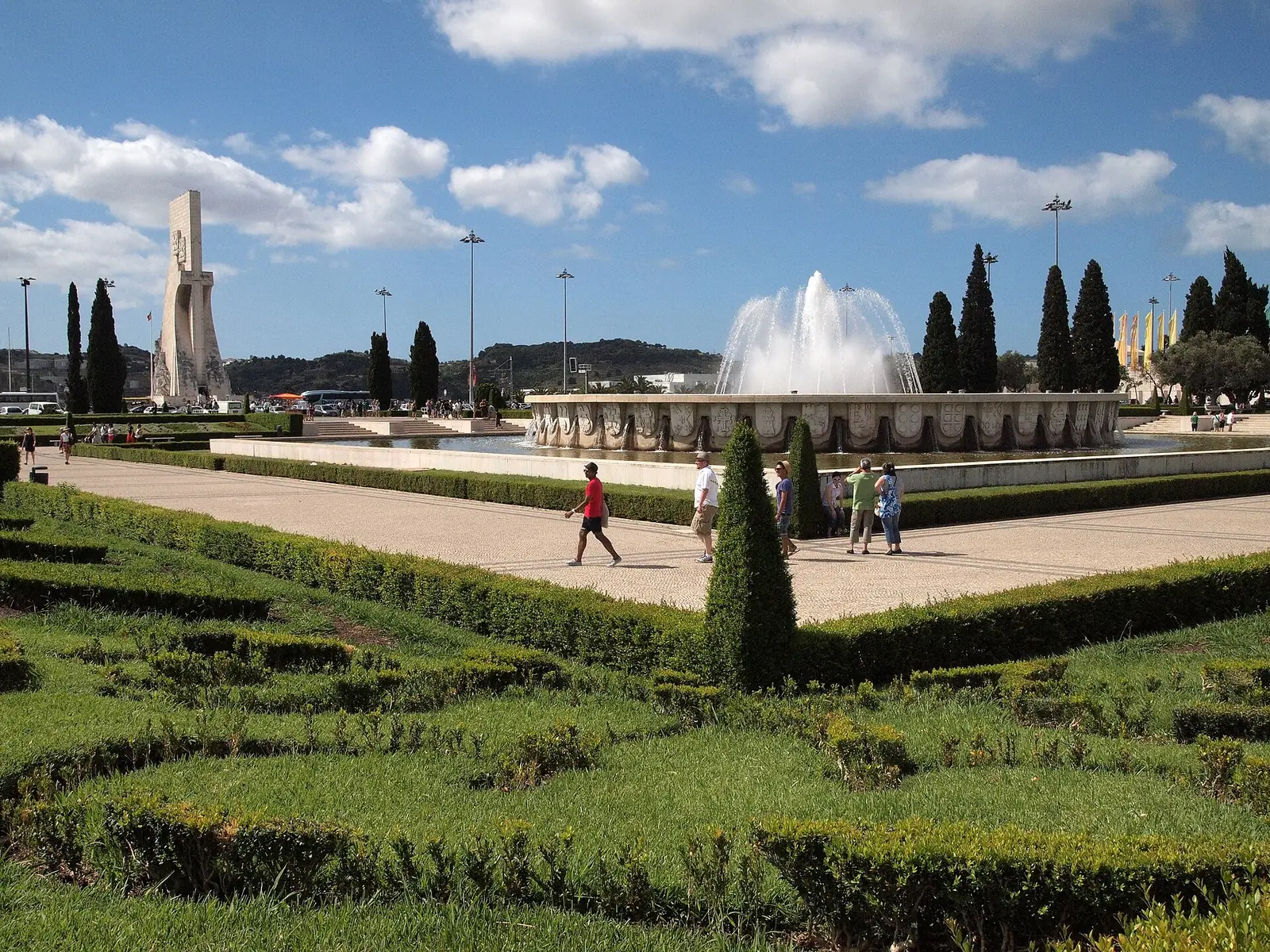
The garden of Praça do Império in August 2012, before the renovation, with the Fonte Monumental in the centre and the Padrão dos Descobrimentos in the background, on the left. paul Barker Hemings, CC BY-SA 2.0 This square was laid out for the Exhibition of the Portuguese World, which opened on 23 June 1940, the day after the armistice between France and Germany. To make way for it, working-class houses and shops in Belém were demolished.2 In the centre, the Fonte Monumental; around it, the pavilions of the Portuguese in the World and of Honour and of Lisbon.5
The empire was the centrepiece. The Colonial Act of 1930 had stated: “It is of the organic essence of the Portuguese Nation to fulfil the historic function of possessing and colonising overseas domains and of civilising the native populations”.12 The Portuguese Colonial Exhibition, in Porto, in 1934, and the one in Belém were the largest undertakings of this “collective pedagogy” of the empire, writes Cláudia Castelo; the one in Belém had some three million visits.2
In January 1975, by the Jerónimos Monastery, people who had arrived from the colonies demonstrated here: “Decolonisation Yes! Discrimination No!” (Descolonização Sim! Discriminação Não!), read a placard.13 And in 2014 the renovation of the garden sparked a controversy over the floral coats of arms of the former colonies, planted in the 1960s; the garden reopened in 2023, with the coats of arms of the district capitals remade in stone mosaic paving (calçada).14 In those debates, notes the historian Márcia Chuva, the “human zoos” of 1940 were forgotten.15
To stop 3350 m · 5 min on foot
Stop 3: : 1940 — the people on displayToday: Tropical Botanical Garden — National Museum of Natural History and Science (University of Lisbon)
Largo dos Jerónimos, 1, 1400-209 Lisboa
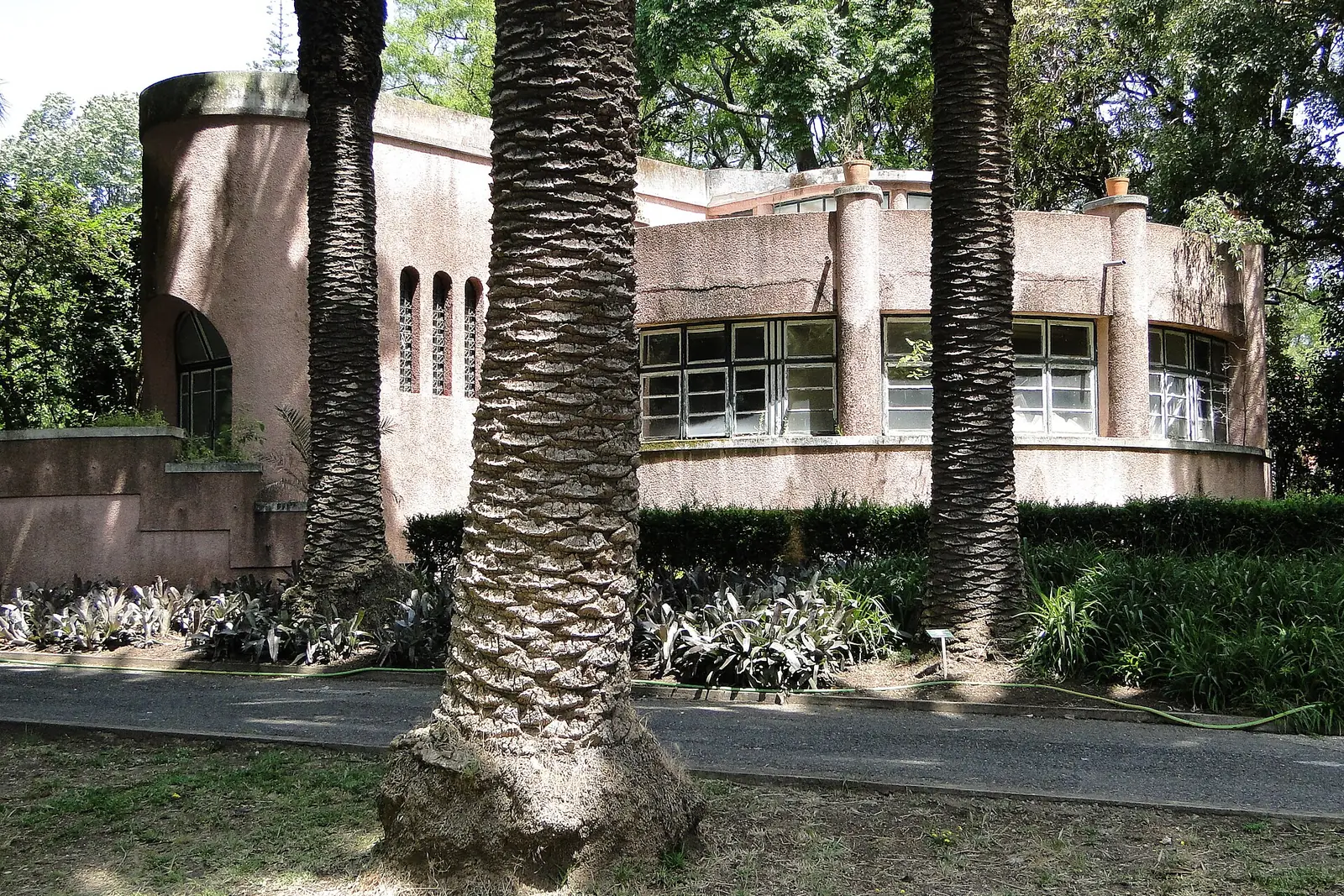
The former Colonial Restaurant of the 1940 exhibition, among palm trees, in the Tropical Botanical Garden, in May 2010. Adam Jones, CC BY-SA 2.0 The former Colonial Garden housed the exhibition’s Colonial Section, directed by Captain Henrique Galvão, who years later would break with the regime and, in 1961, seize the liner Santa Maria.216 The programme, the Diário de Lisboa reported, made it possible “in two hours, for the visitor to travel through the whole of our empire, from Africa to the Pacific, with stopovers of true enchantment”.2 Among pavilions and replica villages, 138 men, women and children brought from the colonies lived here for months, in a “human zoo”, as the historian Cláudia Castelo calls it.2 The Bijagós from Guinea were put on the island in one of the lakes, “for the delight of visitors”, as the garden’s museum writes today.17 “It is forbidden to enter the native villages, but all of them are perfectly visible from outside the palisades”, warned the official guide.2
Of the women, few traces remain: the queen and the princess of Kongo, who came with the king, Dom Pedro VII; Verónica, the wife of a Timorese chief, who came with her husband, two children, a manservant and a maidservant; Chopi women from Mozambique, photographed at a sewing class given by a missionary nun; and a woman sent from Manica and Sofala, whose photograph, writes Castelo, “expresses longing for home on arrival in Lisbon”. How they lived through the journey and the exhibition, “we know little”, the historian admits. Teams of scientists came every day to measure the “indígenas” (natives), in anthropometric studies; in October the exhibition committee decided to send all these people back before the winter, citing health reasons. Their names are in the exhibition papers kept in the Overseas Historical Archive, in Junqueira, which this route passes through.2
Still here are the fourteen busts of African and Asian “types” sculpted for the exhibition, and the colonial house and restaurant. The museum says it is giving them new meaning, together with the communities of origin.17
To stop 4650 m · 10 min on foot
Stop 4: : 1966 and 1974 — the regime’s ladies and an independenceToday: Palácio de Belém – Presidency of the Republic
Praça Afonso de Albuquerque, Lisboa
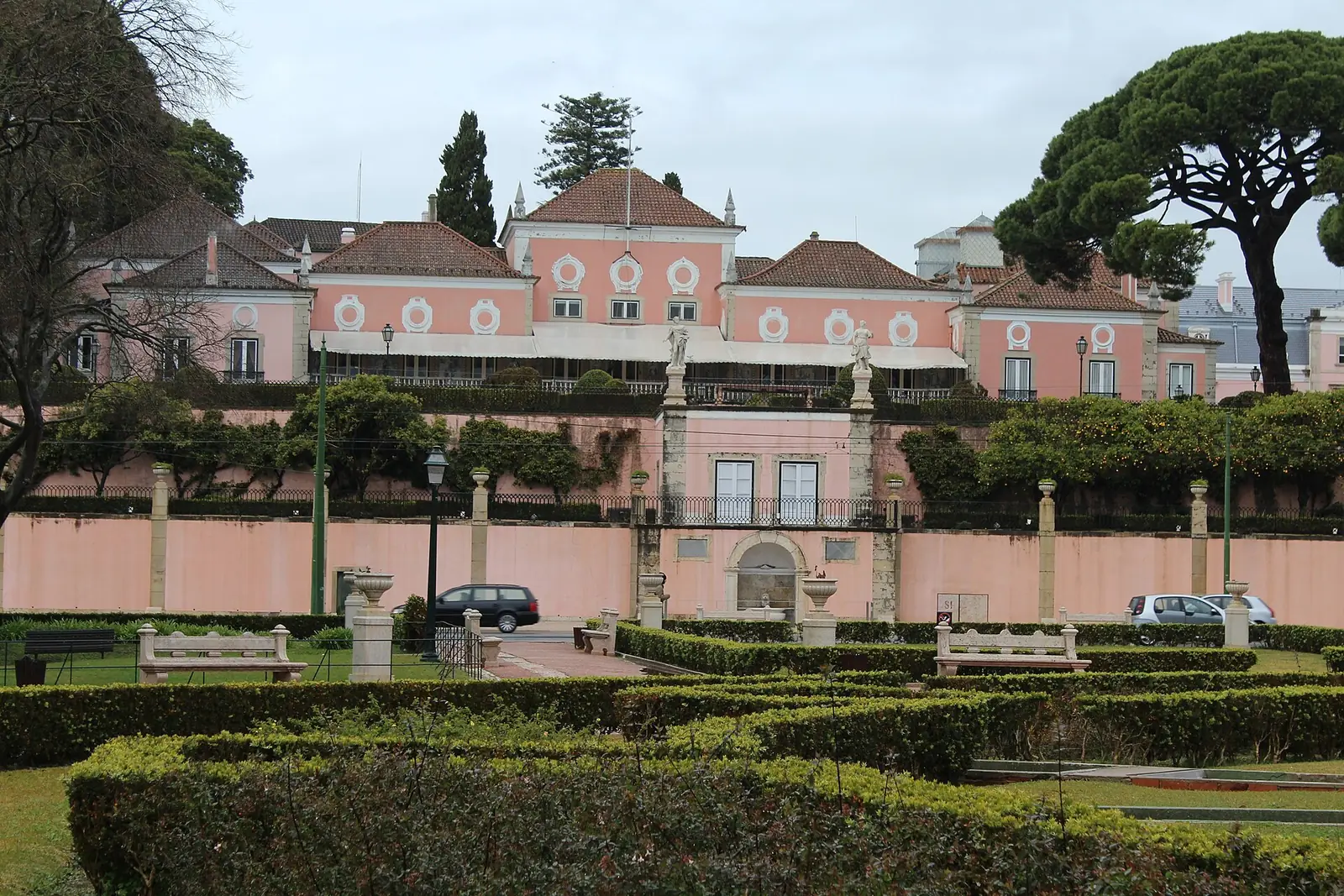
The Palácio de Belém, official residence of the President of the Republic, seen from the gardens of Praça Afonso de Albuquerque, in 2017. Dguendel, CC BY 4.0 In May 1966 the President of the Republic, Américo Tomás, received at this palace the central committee of the National Women’s Movement’s “Hora Voluntária de Trabalho” (Voluntary Hour of Work) — Cecília Supico Pinto, Renata Cunha e Costa, Clara Taborda do Couto and Maria Arminda de Certima — and symbolically handed them one hour of his working day.18 Founded in 1961, the movement put women at the service of the war — the “war godmothers” (madrinhas de guerra) wrote to the soldiers — and it issued more than 300 million aerogrammes.1920 In 1971, in an RTP programme, Cecília Supico Pinto showed the support for soldiers’ families, the layettes, the aerogrammes and “Operação Saudade” (Operation Longing), in which women from the movement flew by helicopter into the bush.21
In its magazines, the movement asked Portuguese mothers to sacrifice their sons “for the Nation”.22 In the letters and aerogrammes studied by the historian Joana Pontes, those who write back to the soldiers are their mothers, war godmothers and friends — rarely their fathers.23
The MFA Programme held as a principle that “the solution to the wars overseas is political and not military”; on 27 July 1974, Law No. 7/74 drew from it the recognition of the right to self-determination and the “acceptance of the independence of the overseas territories”.24 On 10 September, in this palace, Portugal recognised the independence of Guinea-Bissau — and the President, Spínola, used the ceremony to attack the course of decolonisation and to appeal to the “silent majority” (maioria silenciosa).25
To stop 5910 m · 15 min on foot
Stop 5: : 1902 — the medicine of empireToday: Cordoaria Nacional; the building houses the Navy Historical Archive
Avenida da Índia / Rua da Junqueira, Lisboa
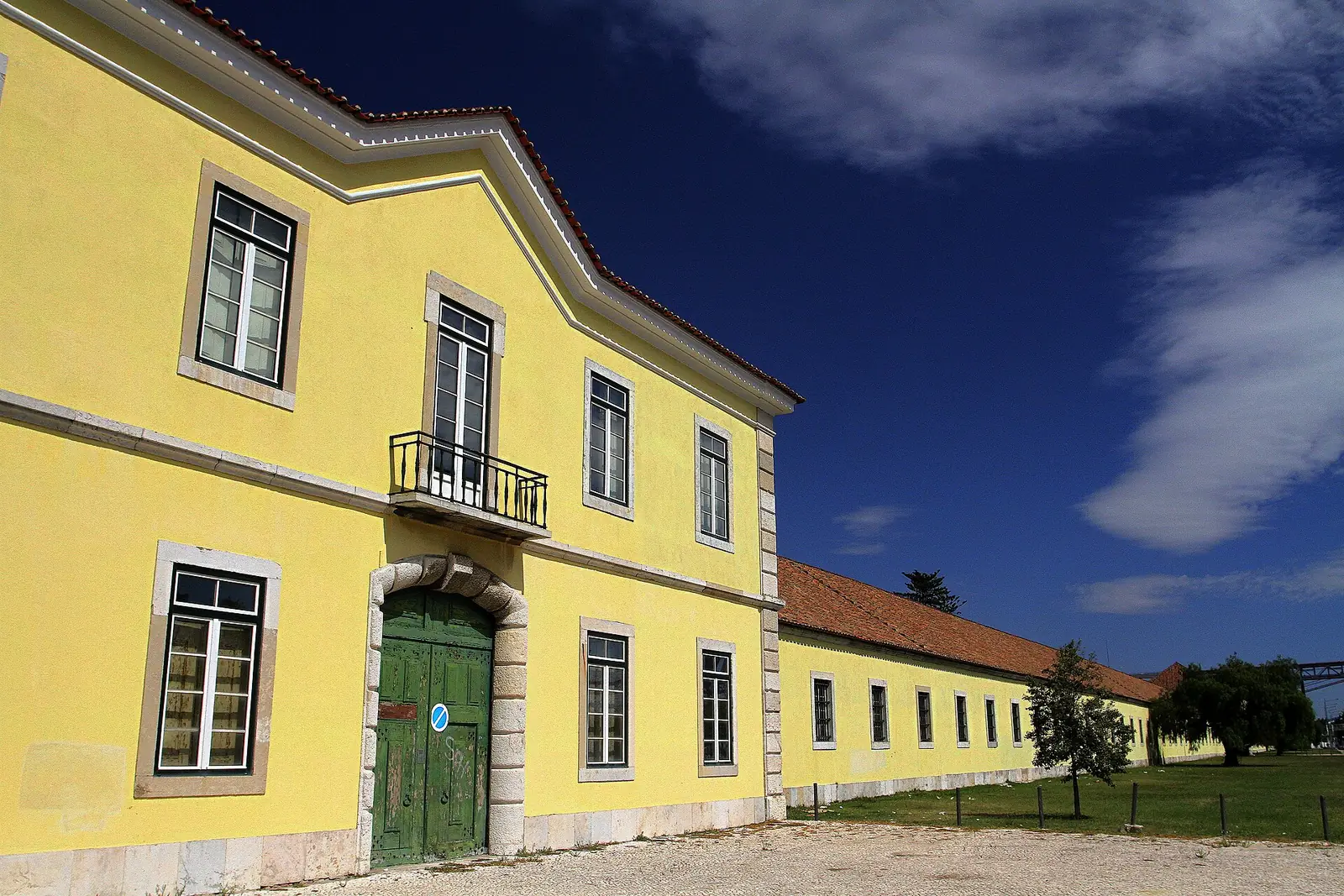
The Cordoaria Nacional in September 2011: a two-storey block and, behind it, the long, low wing of the former Royal Ropeworks (Real Fábrica da Cordoaria). Joaomartinho63, CC BY-SA 3.0 From here on, Rua da Junqueira lines up the institutions of the empire. In this building, the former Royal Ropeworks (Real Fábrica da Cordoaria), the School of Tropical Medicine and the Colonial Hospital were installed in 1902, created by the same law, of 24 April.2627 The hospital treated officials and soldiers “who were returning from overseas in deplorable physical condition with infectious diseases”; the school trained the doctors who went to the colonies.27
Here too, women from the colonies were objects of study: in 1953 the Anais (Annals) of the Institute of Tropical Medicine published an analysis of the breast milk of women in São Tomé, signed by Gabriel Jorge Janz and Gabriela Lopes Pinto. She was one of the Institute’s few women researchers between 1943 and 1966, who were nearly always co-authors with male colleagues and are almost absent from the institution’s official history.28
From 1925 the hospital gradually moved to buildings of its own further along this street — it became the Overseas Hospital (Hospital do Ultramar) and is today Egas Moniz Hospital — and the Institute followed in 1958.2627
To stop 6630 m · 9 min on foot
Stop 6: : 1962 — the school of empireToday: A palace awaiting restoration, approved in 2024, as the headquarters of Museus e Monumentos de Portugal
Rua da Junqueira, 78, 1300-344 Lisboa
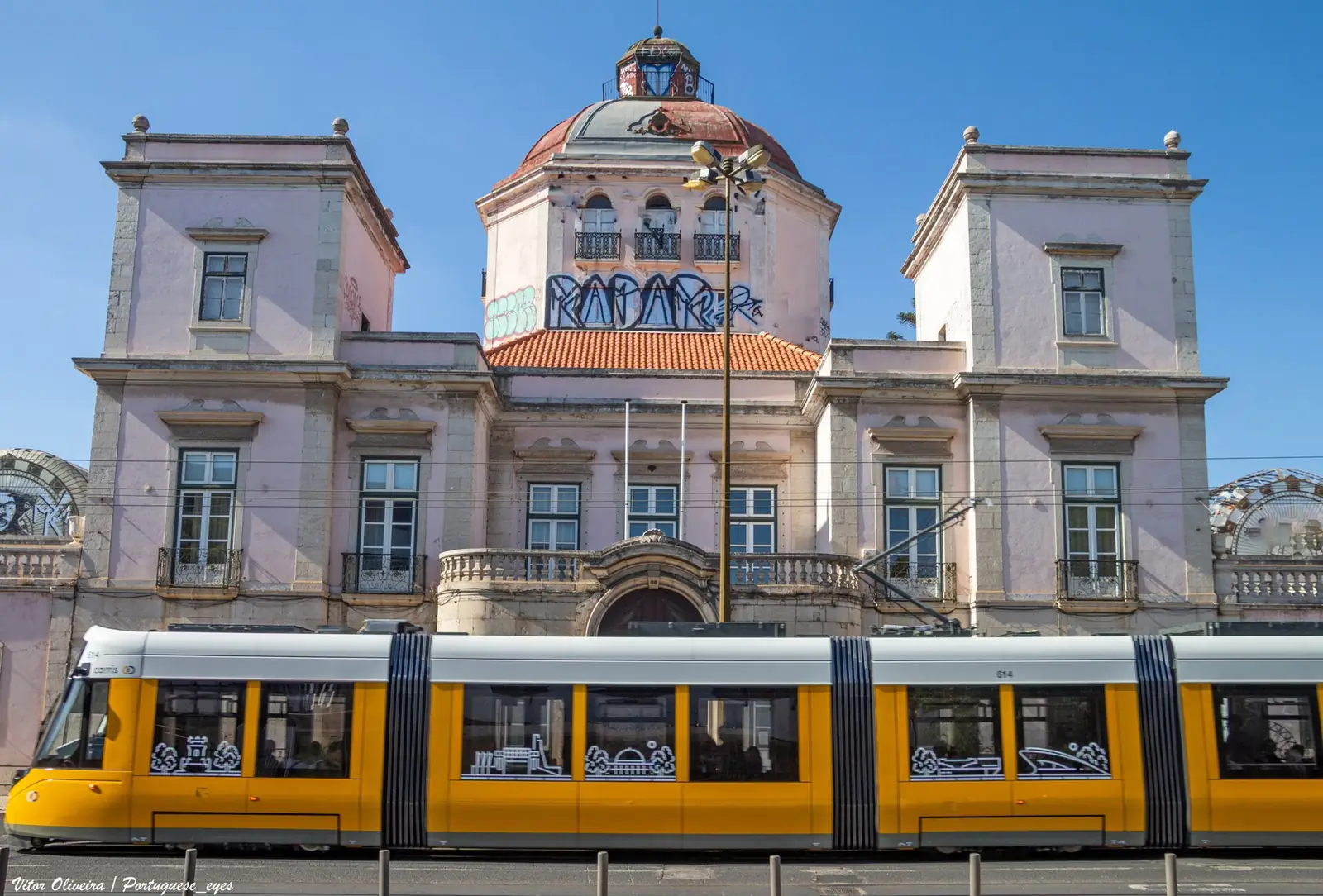
The Palácio Burnay, on Rua da Junqueira, in September 2024: graffiti on the façade and a tram passing. Vitor Oliveira, CC BY-SA 4.0 Along the way you passed the Palácio da Ega, bought by the State in 1919, which became home to the Colonial Historical Archive, created in 1931 and now the Overseas Historical Archive.29 It was conceived as a monument to the imperial past, but it also holds, write the historians Ricardo Roque and José Miguel Ferreira, records of “voices and actions that the colonial order sought to dominate or marginalise”30 — among them, the papers with the names of the people put on display in 1940.2
This palace was bought in 1940 by the Ministry of the Colonies, which installed the councils and boards of the empire here.31 In 1962 the school for colonial administrators arrived: founded in 1906 as the Colonial School, the Higher Colonial School from 1926 and the Higher Institute of Overseas Studies from 1954, it was inaugurated in this palace by Américo Tomás on 20 November 1962 and renamed, four days later, the Higher Institute of Social Sciences and Overseas Policy.32 For the researcher Frederico Ágoas, these changes of name were above all “political cosmetics and propaganda” in defence of the empire.31 One of the professors at the Higher Colonial School, António de Almeida, had in 1940, with Artur Ricardo Jorge, led the measuring of the people put on display in the Colonial Garden.2
After independence, many of the belongings of the “retornados” (returnees from the former colonies) ended up in this street: hundreds of containers were left in the former Lisbon International Fair building, right next door, and in 1977 RTP filmed crates still stored “in a warehouse on Rua da Junqueira”.3334
To stop 71.4 km · 20 min on foot
Stop 7: : 1970 — against the war machineToday: Doca de Alcântara
Doca de Alcântara, Porto de Lisboa, 1399-049 Lisboa
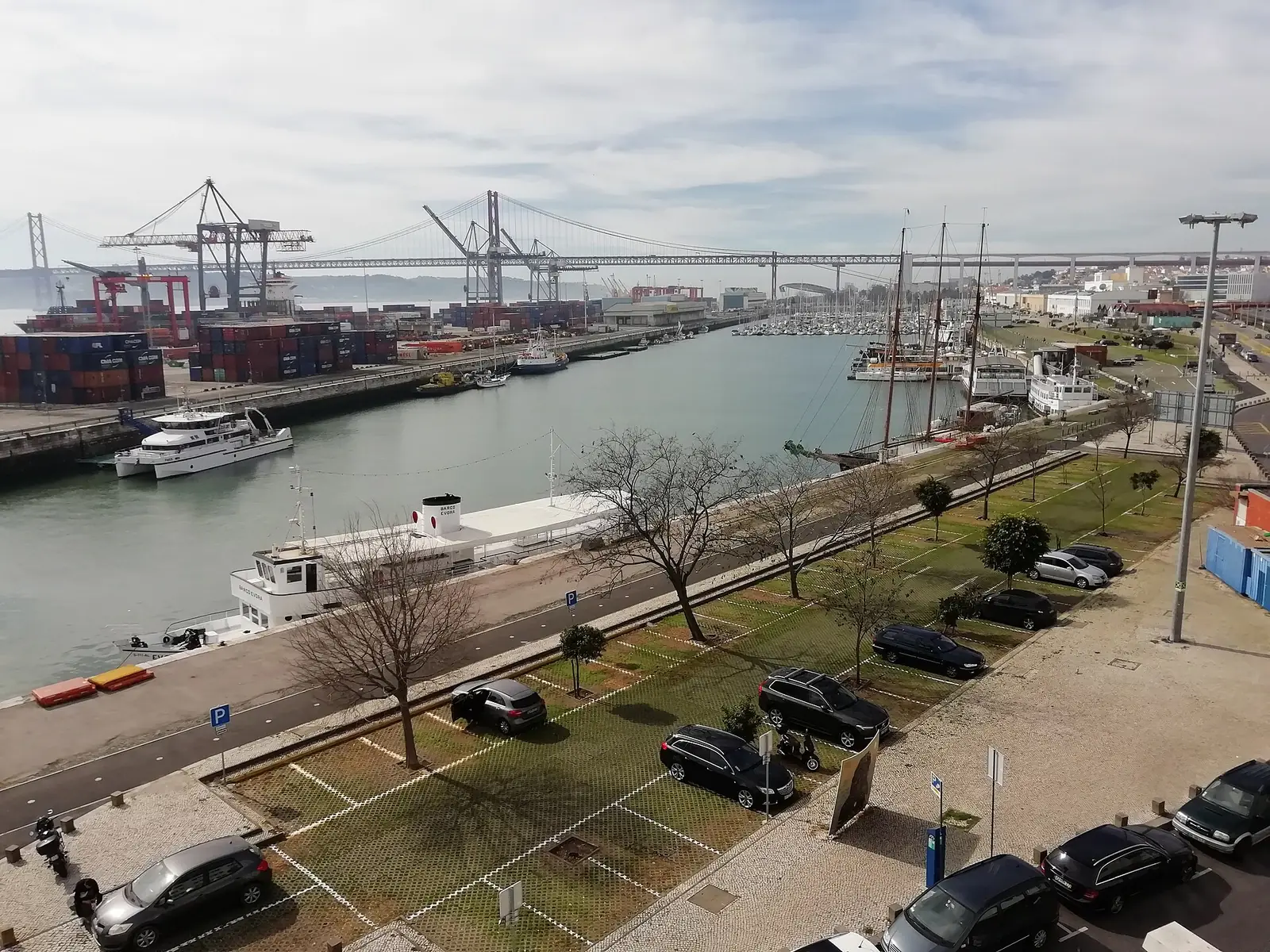
The Alcântara Dock, with the container quay and the 25 de Abril Bridge in the background, in 2020. Lopo Pizarro, CC BY-SA 4.0 In October 1970, two explosions left the freighter Cunene, which supplied the colonial troops, “flooded and immobilised” in this dock, according to the communiqué of 26 October with which Armed Revolutionary Action (ARA) claimed its first action. The ARA, the armed organisation of the Portuguese Communist Party (PCP), was active until 1973, against the colonial war and the dictatorship.35
There were women in this struggle. In the group that set up the ARA in 1970 was Maria Machado, born in 1949 into a communist family, who at the age of eleven joined her parents in one of the PCP’s clandestine houses; she took part in preparing several actions, and only came out of hiding on 1 May 1974.36 Emília Morgado joined the ARA in July 1970 with her husband, Ramiro Morgado, who took part in the destruction of the Cunene.37 In the same year, in a split in the PCP over armed struggle, Isabel do Carmo and Carlos Antunes gave rise to the Revolutionary Brigades, which in July 1972 destroyed fifteen Army lorries bound for the war and let loose pigs dressed as admirals in the Rossio and in Alcântara.3839
- 26 Oct 1970The ARA sabotages the ship “Cunene” in the Alcântara dock
- 7 Nov 1971First armed action of the Revolutionary Brigades
- Jul 1972The Revolutionary Brigades release “admiral” pigs on the Rossio
Isabel do Carmo, in a testimony recorded by the Aljube Museum on 24 April 2019. The museum’s keywords include the student movement, life underground, the armed struggle, imprisonment, torture and isolation in Caxias, and imprisonment after 25 April.
Original page Licença padrão do YouTube — embed permitido pelo canal oficial do Museu do Aljube
Museu do Aljube Resistência e Liberdade, on YouTube. The player only connects to that site when you press “Watch”.
To stop 8130 m · 2 min on foot
Stop 8: : 1961–1975 — departures and returnsToday: A maritime station and the Almada Murals Interpretation Centre
Gare Marítima de Alcântara, 1350-355 Lisboa
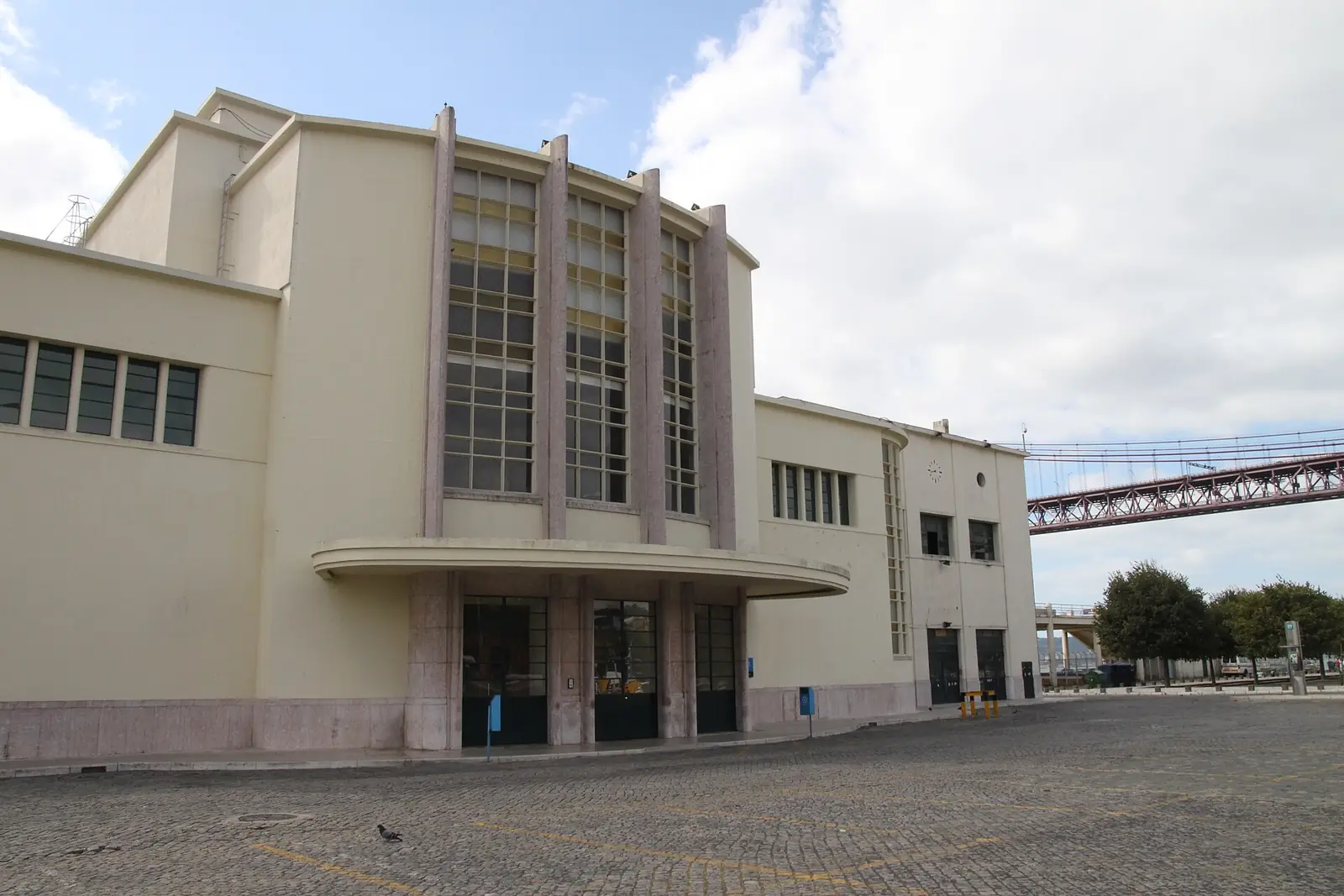
The entrance of the Alcântara Maritime Station, on the land side, in September 2011, with the 25 de Abril Bridge on the right. João Carvalho, CC BY-SA 3.0 The station was supposed to open for the 1940 exhibition, but it was only inaugurated in 1943; on its walls, instead of the regime’s heroes, Almada Negreiros painted the poor people of the river and the hard labour of the women coal-heavers on the quay.4041 From 21 April 1961, when the Niassa took the first contingent sent by sea to Angola, the soldiers left mainly from the Rocha do Conde de Óbidos quay, a kilometre to the east, but also from this one: RTP filmed embarkations at the Alcântara quay in 1961, 1962 and 1964 — “soldiers’ relatives wave white handkerchiefs”, the archive records.423434445
“Theirs — mothers, sisters, wives, girlfriends — are the faces contorted with pain at the farewells on the embarkation quay”, writes the researcher Margarida Calafate Ribeiro.22 The National Women’s Movement was always at the embarkations and, according to the historian Sara Primo Roque, would not let the women cry: those who cried were called “abject wailing women” (abjetas carpideiras).19 It was on this quay, where she had come with a colleague who was saying goodbye to her boyfriend, called up for Guinea, that the nurse Maria de Lourdes Gomes saw that there were women in the military and heard of a new course for paratrooper nurses; she signed up, and gained her parachutist’s brevet in 1970.49 Photographs of the embarkations disappeared from the newspapers from 1969 onwards, and from 1971 the troops went by air.2242 Not everyone went: more than eight thousand Army soldiers deserted — some nine thousand, according to the Commemorative Commission — and it is estimated that between 10,000 and 20,000 young men were draft evaders, refusing to go, and that some 200,000 failed to report for the military inspection.50511
Through the same quay came African students bound for the House of the Students of the Empire, and African women brought to work as maids in the homes of white employers.4 In 1975, as the colonies became independent, more than half a million people arrived, and the crates holding what they had been able to bring covered this quay for months — “the strongest and most symbolic images of the end of European colonialism”, says the interpretation centre housed in the station.4


.jpg)
_-_Belem_District_-_Lisbon,_Portugal_(4633075739).jpg)


.jpg)


History
In Belém, the Estado Novo (“New State”) staged the empire. In 1940 the Exhibition of the Portuguese World celebrated, in the words of the time, “the victory of the race in eight centuries of history”, and brought 138 men, women and children from the colonies to be seen by the visitors.2 A little over twenty years later, with the war in Angola already under way, it was from the Alcântara and Rocha do Conde de Óbidos quays that the soldiers left for Africa; and it was to those quays that, in 1975, the crates of those returning from the former colonies came back.34
The walk goes from the Padrão dos Descobrimentos (Monument to the Discoveries) to the quay at Alcântara along Rua da Junqueira, where the institutions of the empire were lined up: the hospital and the school of tropical medicine, the colonial archive, the school for the administrators of the colonies. It lets both voices be heard — that of the regime, quoted as the propaganda it was, and that of the colonised, almost always silent in the records — and at each stop it looks for the women of this story: those put on display in 1940, the ladies of the National Women’s Movement, the mothers and girlfriends on the quay, the paratrooper nurses, the women activists who attacked the war machine.
The African students, women and men, who prepared the ground for independence in Lisbon — Alda do Espírito Santo, Noémia de Sousa, Amílcar Cabral, Agostinho Neto — have their place in the route Students against the dictatorship, at the House of the Students of the Empire and at the Centre for African Studies.
Before you go
- Start
- Padrão dos Descobrimentos (Monument to the Discoveries), in Belém — Train at Belém (Cascais line); tram 15; buses 714, 727, 728, 729 and 751
- Finish
- Alcântara Maritime Station — Train at Alcântara-Mar (Cascais line), about 300 metres away; trams 15 and 18 at the Alcântara – Avenida 24 de Julho stop
- Accessibility of the route
- An almost flat route, nearly all of it along the river. Between the Padrão and the Praça do Império you cross the avenue and the railway line by an underpass next to the Centro Cultural de Belém, with steps and a ramp, according to OpenStreetMap. The Tropical Botanical Garden climbs northwards, up to the Palácio dos Condes da Calheta, but the stop is at the entrance. To reach the dock and the maritime station at Alcântara you cross the railway line again: by Alcântara-Mar station there are level crossings and an underpass with steps and no ramp, also according to OpenStreetMap.
The walk, the photos and the map stay on the phone, to open anywhere.
Dates
8 Jul 1930
16 Jun 1934
23 Jun 1940
27 Jun 1940
10 more dates
21 Apr 1961
28 Apr 1961
8 Aug 1961
26 Oct 1970
7 Nov 1971
Jul 1972
27 Jul 1974
10 Sep 1974
28 Sep 1974
Aug 1975
Notes on the sources4
- The names of the 138 people put on display in 1940, which are in the exhibition papers kept in the Overseas Historical Archive, according to Cláudia Castelo: none of the sources consulted publishes them.
- Whether the “warehouse on Rua da Junqueira” where RTP filmed crates belonging to “retornados” in 1977 was the former Lisbon International Fair building, where the journalist Guilherme de Melo places the containers.
- In which years, besides those filmed by RTP (1961, 1962 and 1964), troops embarked at the Alcântara quay.
- The day the National Women’s Movement was received at Belém: the RTP news bulletin is dated 18 May 1966.
Do you know more, or do you have a document? Tell us.
Sources53
- 1Guerra à Guerra: uma reivindicação tardia do movimento estudantil (Primaveras estudantis). Comissão Comemorativa 50 Anos 25 de Abril — consulted on 3 October 2026
- 2Cláudia Castelo, Simulação e dissimulação do império colonial português em Belém, Lisboa (1940/2020): a secção colonial e o jardim botânico tropical. Anais do Museu Histórico Nacional (Rio de Janeiro), vol. 54, 2021 — consulted on 3 October 2026
- 3Partidas. Centro Interpretativo Murais de Almada nas Gares Marítimas (Câmara Municipal de Lisboa, Administração do Porto de Lisboa) — consulted on 3 October 2026
- 4Chegadas. Centro Interpretativo Murais de Almada nas Gares Marítimas (Câmara Municipal de Lisboa, Administração do Porto de Lisboa) — consulted on 3 October 2026
- 5Padrão dos Descobrimentos: a obra, 1940 e 1960. Padrão dos Descobrimentos (EGEAC) — consulted on 3 October 2026
- 6O conjunto escultórico. Padrão dos Descobrimentos (EGEAC) — consulted on 3 October 2026
- 7Rosa dos Ventos. Padrão dos Descobrimentos (EGEAC) — consulted on 3 October 2026
- 8José Pedro Monteiro, Rosa-dos-Ventos. Centro de Estudos Sociais da Universidade de Coimbra — projeto ECHOES (exposição Lisboa) — consulted on 3 October 2026
- 9Helena Matos, Os retornados começaram a chegar há 40 anos. Observador, 2014 — consulted on 3 October 2026
- 10Exposição «Retornar – Traços da Memória» (Noticiário, 4 de novembro de 2015). RTP Arquivos, 2015 — consulted on 3 October 2026
- 11Sílvia Correia, Memórias enredadas das guerras e do colonialismo (Monumento aos Combatentes). Centro de Estudos Sociais da Universidade de Coimbra — projeto ECHOES (exposição Lisboa) — consulted on 3 October 2026
- 12Ato Colonial. Museu do Aljube Resistência e Liberdade (EGEAC) — consulted on 2 October 2026
- 13Manifestação de refugiados do Ultramar (Informação Diária, janeiro de 1975). RTP Arquivos, 1975 — consulted on 3 October 2026
- 14Inaugurado «novo» Jardim da Praça do Império. RTP Notícias (Lusa), 2023 — consulted on 3 October 2026Publicado a 14 de fevereiro de 2023.
- 15Márcia Chuva, Praça do Império. Centro de Estudos Sociais da Universidade de Coimbra — projeto ECHOES (exposição Lisboa) — consulted on 3 October 2026
- 16Henrique Galvão. Museu do Aljube Resistência e Liberdade (EGEAC) — consulted on 2 October 2026
- 17Jardim Botânico Tropical. Museu Nacional de História Natural e da Ciência — Universidade de Lisboa — consulted on 3 October 2026
- 18Américo Tomás recebe Movimento Nacional Feminino (Noticiário Nacional, 18 de maio de 1966). RTP Arquivos, 1966 — consulted on 3 October 2026
- 19As madrinhas de guerra foram um «sintoma» político e social durante o Estado Novo. Gerador — consulted on 3 October 2026
- 20Movimento Nacional Feminino. Wikipédia (português) — consulted on 2 October 2026
- 21Um Dia Com… Movimento Nacional Feminino (17 de maio de 1971). RTP Arquivos, 1971 — consulted on 3 October 2026
- 22Margarida Calafate Ribeiro, África no feminino: as mulheres portuguesas e a Guerra Colonial. Revista Crítica de Ciências Sociais, n.º 68 (CES), 2004 — consulted on 3 October 2026
- 23Livros no Aljube – Sinais de vida – Cartas de Guerra (1961-1974). Museu do Aljube Resistência e Liberdade (EGEAC), 2020 — consulted on 3 October 2026
- 24Legislação 25A – Direito das colónias à independência (Lei 7/74 de 27 de Julho). Centro de Documentação 25 de Abril, Universidade de Coimbra — consulted on 2 October 2026
- 2528 de Setembro. Comissão Comemorativa 50 Anos 25 de Abril — consulted on 2 October 2026
- 26Aulas na Escola de Medicina Tropical. Fotografias (peça do mês). Instituto de Higiene e Medicina Tropical — Universidade NOVA de Lisboa, 2021 — consulted on 3 October 2026
- 27História do Hospital de Egas Moniz. Centro Hospitalar de Lisboa Ocidental (SNS) — consulted on 3 October 2026
- 28João Lourenço Monteiro, Mulheres visíveis: uma perspectiva diferente na história do Instituto de Medicina Tropical em Portugal, 1943-1966. História, Ciências, Saúde – Manguinhos, vol. 28, n.º 1, 2021 — consulted on 3 October 2026
- 29Palácio da Ega. Arquivo Histórico Ultramarino (DGLAB) — consulted on 3 October 2026
- 30Ricardo Roque e José Miguel Ferreira, Arquivo Histórico Ultramarino. Centro de Estudos Sociais da Universidade de Coimbra — projeto ECHOES (exposição Lisboa) — consulted on 3 October 2026
- 31Frederico Ágoas, Palácio Burnay – ISCSP(U): ideologia e ciência no ensino colonial. Centro de Estudos Sociais da Universidade de Coimbra — projeto ECHOES (exposição Lisboa) — consulted on 3 October 2026
- 32Escola Colonial (1906-1974). Biblioteca Nacional de Portugal — TECOP, Textos e Contextos do Orientalismo Português — consulted on 3 October 2026
- 33Retornados (Portugalmente, 11 de dezembro de 1998). RTP Arquivos, 1998 — consulted on 3 October 2026
- 34Caixotes de retornados em Lisboa (Noticiário Nacional, 20 de setembro de 1977). RTP Arquivos, 1977 — consulted on 3 October 2026
- 35Primeira ação da Acção Revolucionária Armada (ARA). Museu do Aljube Resistência e Liberdade (EGEAC) — consulted on 2 October 2026
- 36Maria Machado (testemunho e biografia). Museu do Aljube Resistência e Liberdade (EGEAC) — consulted on 3 October 2026Testemunho recolhido a 21 de outubro de 2020.
- 37Raimundo Narciso e Ramiro Morgado (testemunhos e biografias). Museu do Aljube Resistência e Liberdade (EGEAC) — consulted on 3 October 2026Testemunhos recolhidos a 26 de janeiro de 2017.
- 38As Brigadas Revolucionárias realizaram a sua primeira ação armada. Museu do Aljube Resistência e Liberdade (EGEAC) — consulted on 2 October 2026
- 39Primeira ação das Brigadas Revolucionárias (BR). Museu do Aljube Resistência e Liberdade (EGEAC) — consulted on 2 October 2026
- 40Cais. Centro Interpretativo Murais de Almada nas Gares Marítimas (Câmara Municipal de Lisboa, Administração do Porto de Lisboa) — consulted on 3 October 2026
- 41O que contam as paredes. Centro Interpretativo Murais de Almada nas Gares Marítimas (Câmara Municipal de Lisboa, Administração do Porto de Lisboa) — consulted on 3 October 2026
- 42Pedro da Silva Monteiro, A Logística de Portugal na Guerra Subversiva de África (1961 a 1974). Revista Militar, n.º 2539/2540, 2013 — consulted on 3 October 2026
- 43Embarque das tropas para o Ultramar (Telejornal, 24 de agosto de 1961). RTP Arquivos, 1961 — consulted on 3 October 2026
- 44Embarque de tropas para o Ultramar (Noticiário Nacional, 16 de julho de 1962). RTP Arquivos, 1962 — consulted on 3 October 2026
- 45Embarque de tropas para o Ultramar (Noticiário Nacional, 8 de janeiro de 1964). RTP Arquivos, 1964 — consulted on 3 October 2026
- 46Regresso de tropas do Ultramar (Noticiário Nacional, 21 de dezembro de 1964). RTP Arquivos, 1964 — consulted on 4 October 2026Chegada ao cais de Alcântara do navio «Quanza», com um contingente militar regressado de Moçambique.
- 47Regresso de contingente da Guiné (Noticiário Nacional, 3 de maio de 1966). RTP Arquivos, 1966 — consulted on 4 October 2026Desembarque no cais de Alcântara de tropas vindas da Guiné.
- 48Chegada de tropas ao cais de Alcântara (Noticiário Nacional, 3 de março de 1973). RTP Arquivos, 1973 — consulted on 4 October 2026Chegada ao cais de Alcântara, no navio «Timor», de tropas vindas de comissão em Timor e Macau.
- 49Filipa Moreno Figueiredo Caetano, A mobilização feminina durante a Guerra Colonial Portuguesa (1961-1974): o fenómeno das enfermeiras paraquedistas (dissertação de mestrado). RUN – Repositório da Universidade NOVA de Lisboa (NOVA FCSH), 2025 — consulted on 3 October 2026
- 50Investigação inédita indica que mais de oito mil soldados desertaram da Guerra Colonial. RTP Notícias (Lusa), 2016 — consulted on 3 October 2026Publicado a 21 de outubro de 2016.
- 51Os desertores: recusar a guerra, combater o colonialismo (projeto de investigação). Centro de Estudos Sociais da Universidade de Coimbra — consulted on 3 October 2026
- 52Contactos e horários. Padrão dos Descobrimentos (EGEAC) — consulted on 3 October 2026
- 53Nominatim – OpenStreetMap (geocodificação). OpenStreetMap contributors (ODbL) — consulted on 2 October 2026
Other walks
Revolution
The first day
25 April 1974 hour by hour, from the Terreiro do Paço to the Carmo and the door of the political police
- Distance
- 2.3 km
- Duration
- 1 h 30 min
- Stops
- 7 stops
Women
Graça, the women’s hill
Seamstresses on strike, a republican propagandist, a women’s prison, a bar and a poet — Graça as they tell it
- Distance
- 1.7 km
- Duration
- 1 h 15 min
- Stops
- 6 stops
Repression
The Estado Novo, explained
How a dictatorship lasted 48 years: the leader, the façade, the single party, the family, work and propaganda — from São Bento to Restauradores
- Distance
- 4.6 km
- Duration
- 2 h 20 min
- Stops
- 9 stops