Walk · Republic · on foot
Carolina’s vote
The suffragists of the First Republic, from the Baixa to Arroios — doctors, teachers and journalists who asked for the vote, and one who voted
- Distance
- 4.1 km
- Duration
- 1 h 50 min
- Stops
- 6
- Difficulty:
- Moderate
Stops
Map of the walk “Carolina’s vote”, with 6 numbered stops. The list of stops follows the map.
The stops
Stop 1: : A woman doctor’s consulting roomsToday: A building with a shop on the ground floor
Rua Nova do Almada, 84, 1100-225 Lisboa
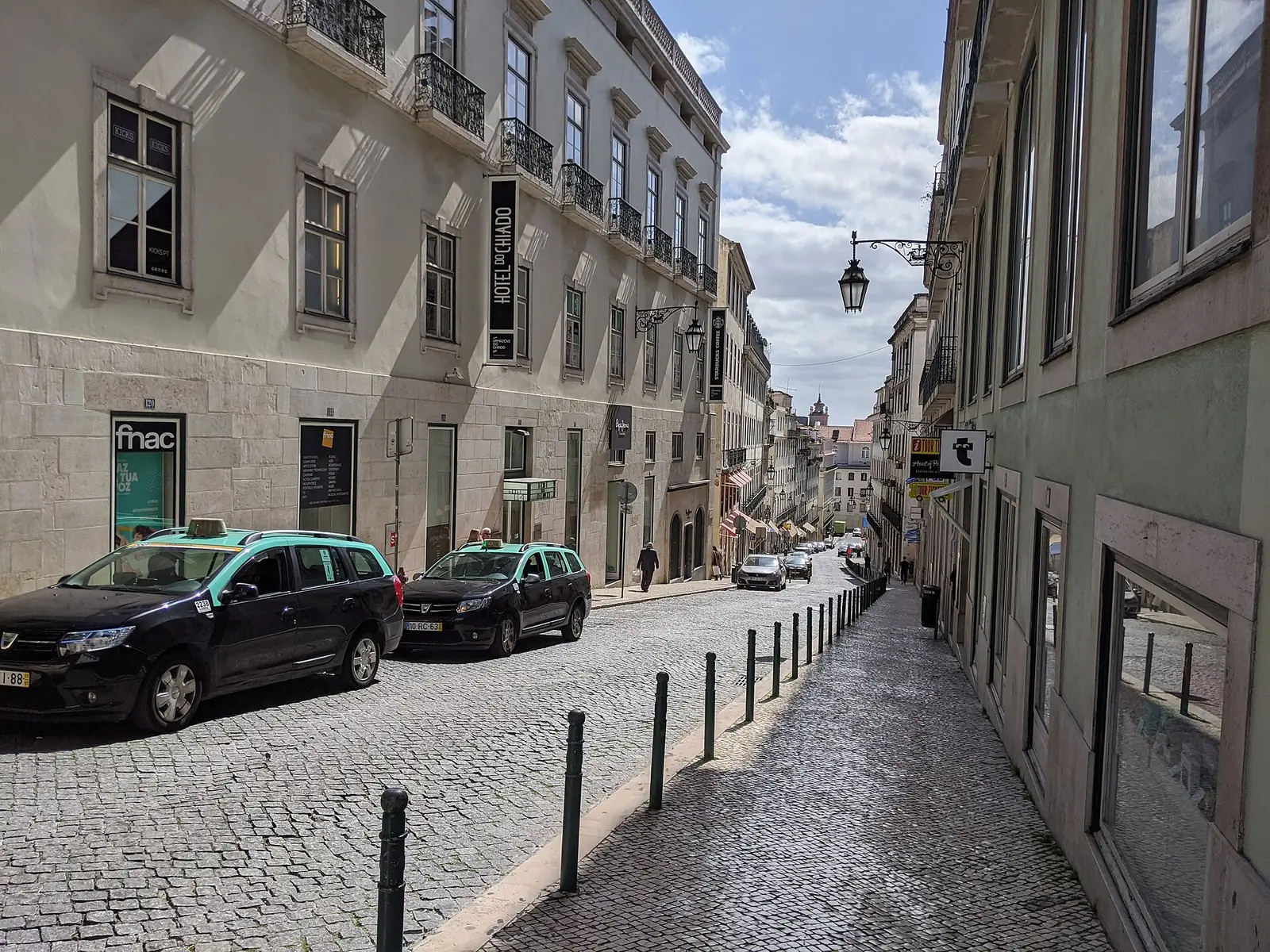
Rua Nova do Almada, in the Chiado, in March 2020. Daniel, CC BY 2.0 Carolina Beatriz Ângelo came from Guarda to study in Lisbon, graduated in medicine in 1902 and devoted herself to gynaecology. An advertisement from 1909 places her consulting rooms here, at No. 84 Rua Nova do Almada.3
The Baixa was also the territory of another feminist doctor: Adelaide Cabete had consulting rooms on Rua da Prata and Rua Áurea before moving to Restauradores, where we go next.4
To stop 2710 m · 10 min on foot
Stop 2: : The Women’s CouncilToday: Praça dos Restauradores, 13
Praça dos Restauradores, 13, 2.º andar, Lisboa
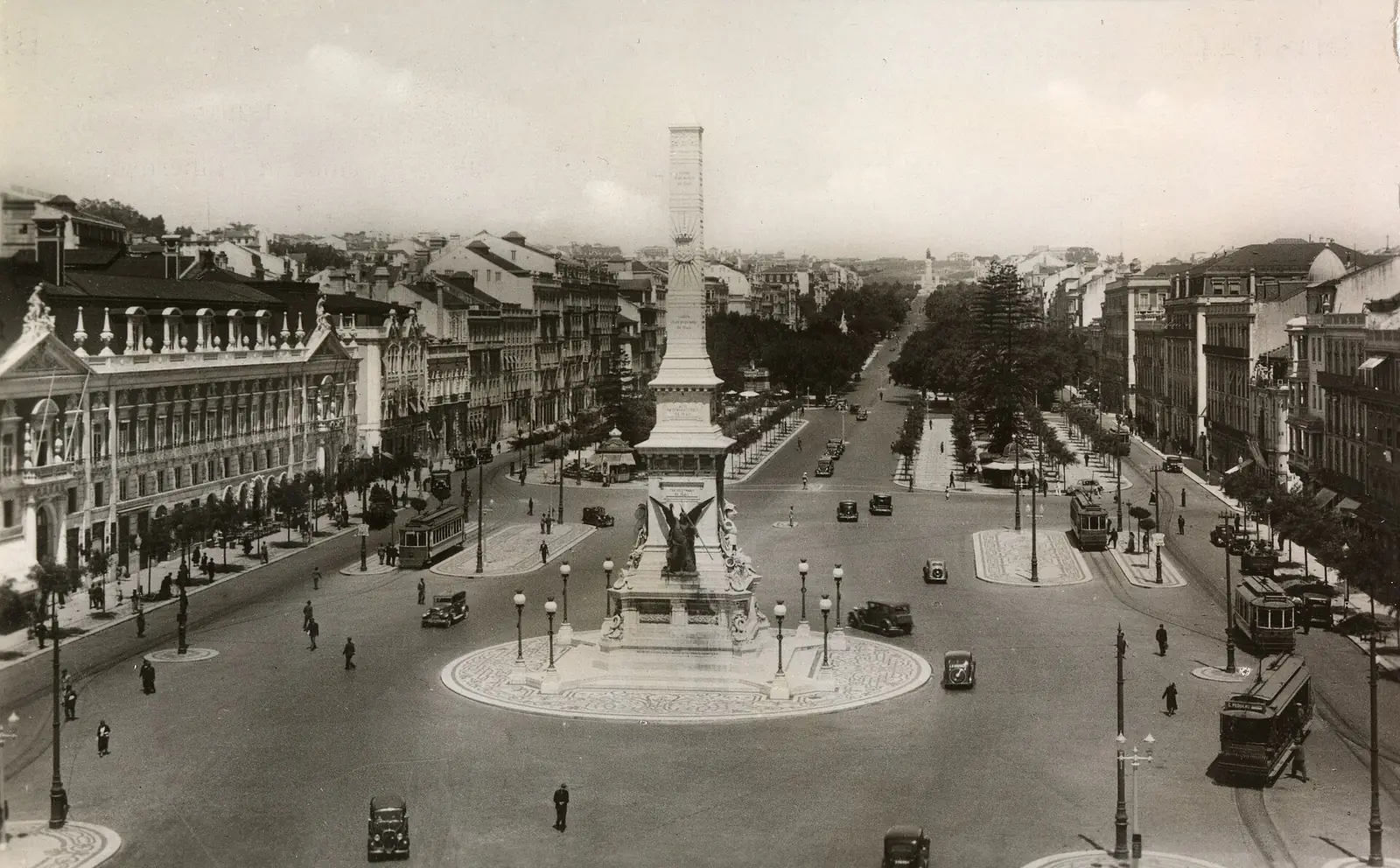
Praça dos Restauradores in 1951, with the Palácio Foz — then the headquarters of the National Information Secretariat (SNI) — on the left and the obelisk in the centre. Autor desconhecido (ETH-Bibliothek Zürich, Bildarchiv), CC BY-SA 4.0 On the first floor of No. 13 in this square, in Adelaide Cabete’s consulting rooms, the National Council of Portuguese Women was born in 1914 — for the historian Rosa de Lurdes Correia, “the most important and longest-lasting Portuguese feminist association of the first half of the twentieth century”. It had its headquarters here for 32 years.5
Adelaide Cabete gave free consultations to poor women.4 The Council lived through the Republic and the dictatorship: it was presided over by Maria Lamas from 1945 and closed by the police in 1947.5
To stop 3870 m · 15 min on foot
Stop 3: : The first woman surgeonToday: São José Hospital
Rua José António Serrano, 1150-199 Lisboa
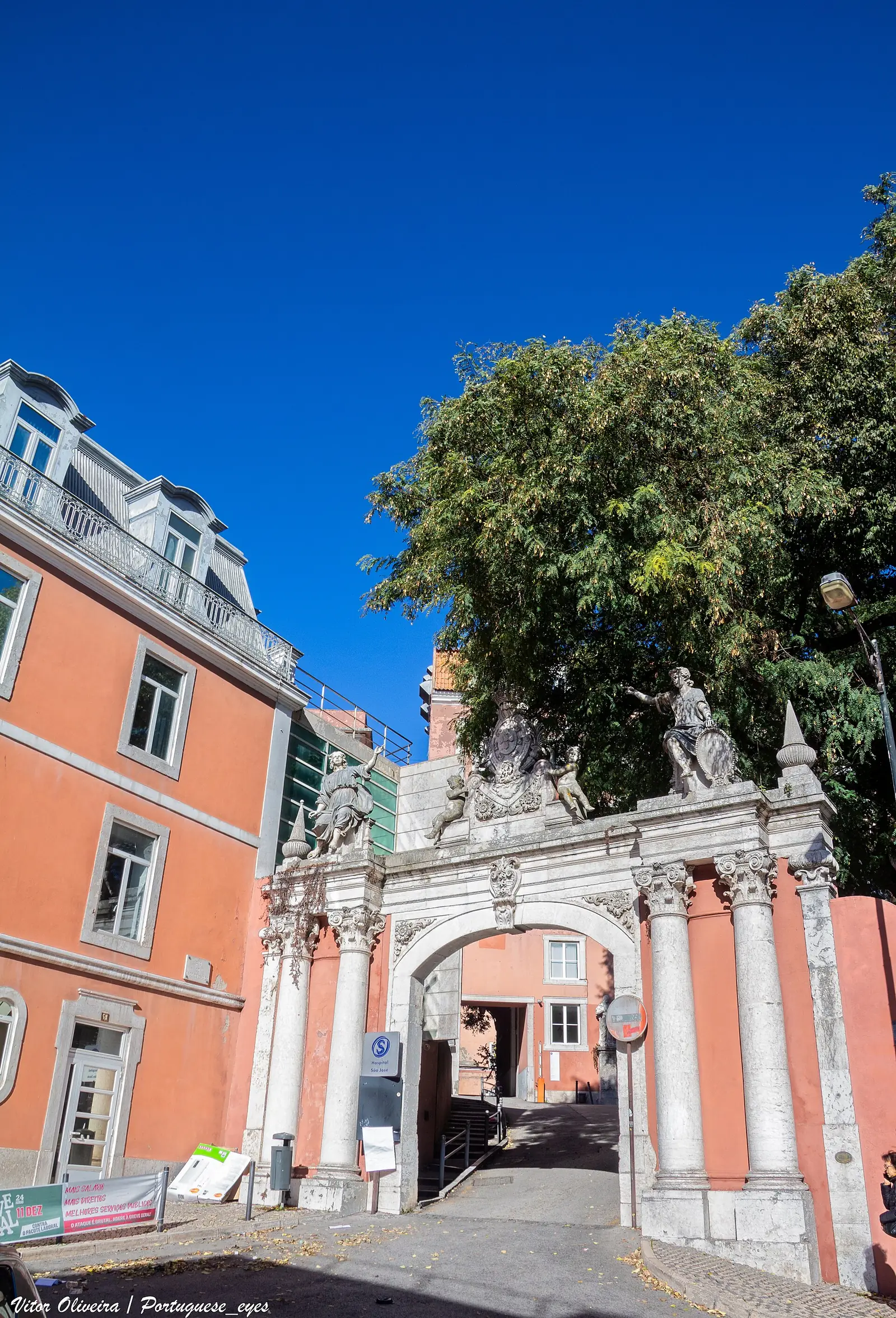
The Baroque gateway of the São José Hospital, in November 2025. Vitor Oliveira, CC BY-SA 4.0 Carolina Beatriz Ângelo was a pioneer in surgery and, according to Lisbon’s street-naming office (Toponímia de Lisboa), the first Portuguese woman doctor to operate in this hospital.3 It was a small generation: in 1906 she, Adelaide Cabete, Domitila de Carvalho, Emília Patacho and Maria do Carmo Lopes joined a women’s movement for peace and disarmament together.3
To stop 4740 m · 10 min on foot
Stop 4: : The Republican League of WomenRua dos Castelinhos, 6, 2.º, Lisboa
Rua dos Castelinhos, 6, 2.º, Lisboa
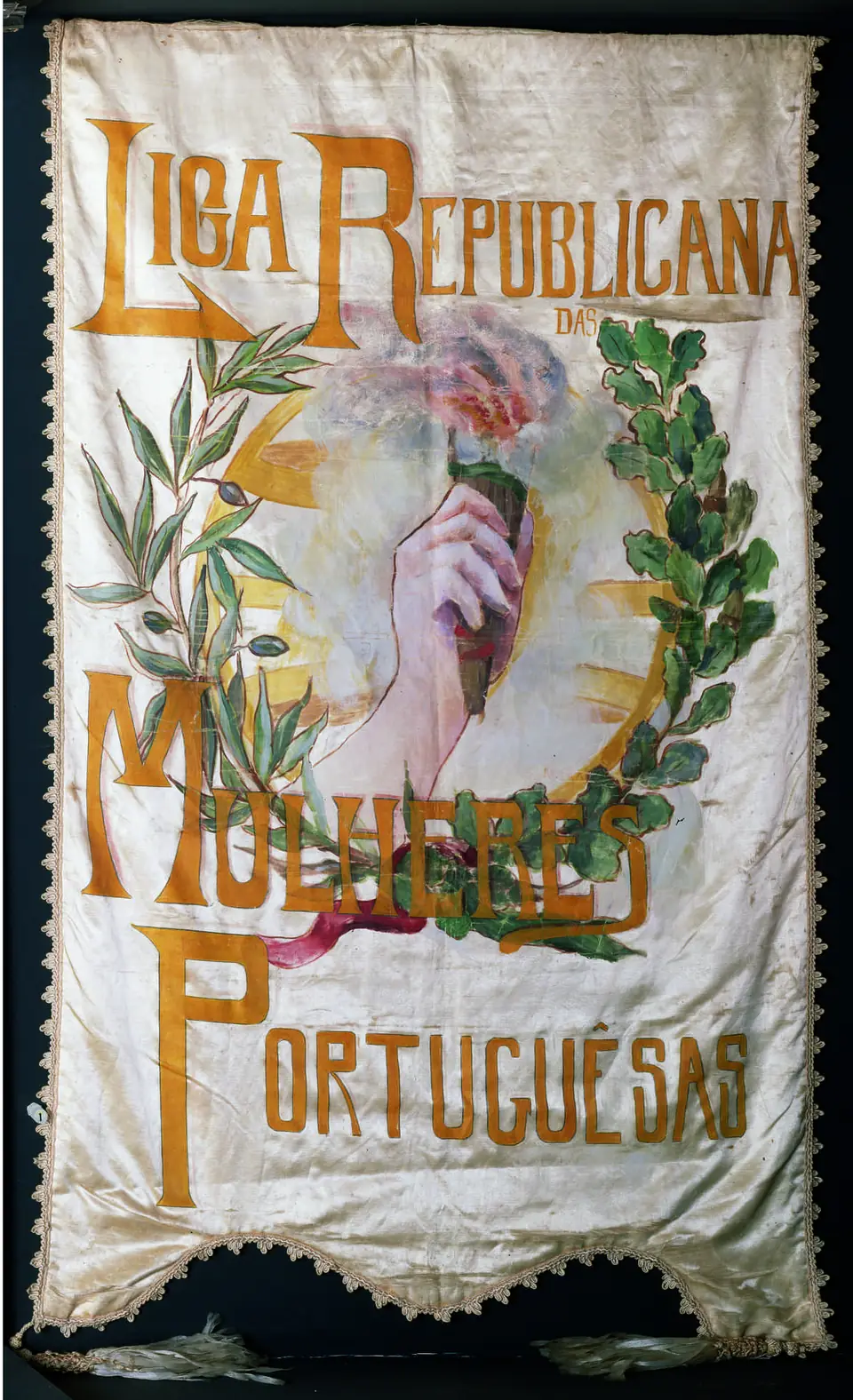
The banner of the Republican League of Portuguese Women, from about 1909–1911. Autor desconhecido, Public domain The Republican League of Portuguese Women was launched in 1908 by Ana de Castro Osório and António José de Almeida, and was formally constituted in February 1909 — according to the street-naming office, on the second floor of No. 6 on this street. It aimed “to guide, educate and instruct Portuguese women in democratic principles” and to change the laws that concerned them.67
After 5 October, the League handed the Provisional Government a long list of feminist demands; among them was the vote, asked for “for now” only for women who were traders, industrialists, civil servants, graduates, writers or managers of a fortune.11 In 1911 it split over which vote to ask for: Ana de Castro Osório wanted it for educated women; Maria Veleda, for all women.1
To stop 51.3 km · 20 min on foot
Stop 5: : The night classesCalçada de Arroios, Lisboa (número por identificar)
Calçada de Arroios, Lisboa (número por identificar)
In 1907 the Portuguese Group of Feminist Studies — women doctors, writers and above all teachers — gave night classes to women who could not read at the Dr Afonso Costa Republican School Centre, here on Calçada de Arroios.8 Teaching women to read also opened the door to the vote: the 1911 law would only give it to those who could read and write, or were heads of household.1
To stop 6410 m · 6 min on foot
Stop 6: : 28 May 1911 — “That’s me!”Rua de Dona Estefânia, 62, Lisboa (sede atual do clube: Rua Alexandre Braga, 24-A, 1150-004 Lisboa)
Rua de Dona Estefânia, 62, Lisboa (sede atual do clube: Rua Alexandre Braga, 24-A, 1150-004 Lisboa)
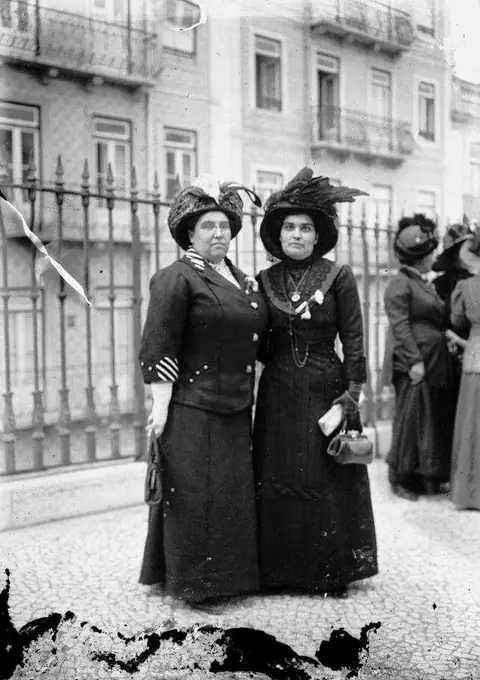
Carolina Beatriz Ângelo, “the first Portuguese woman voter”, with Ana de Castro Osório on election day, 28 May 1911. Photograph by Joshua Benoliel published in the “Ilustração Portuguesa”. Joshua Benoliel, Public domain Turned down by the electoral registration committee, Carolina went to court, and the judge João Baptista de Castro — father of Ana de Castro Osório — ordered her to be registered: by saying “portugueses” (the Portuguese), the law covered both men and women. She became voter No. 2513.2
On the day of the elections to the Constituent Assembly, the polling station for São Jorge de Arroios was here, in the Clube Estefânia, then frequented only by men.10 A voter protested; Carolina pointed out that the law barred only “the insane or the drunk” from voting. At the second call, on hearing her name, she stepped forward — “That’s me!” — and handed in her ballot paper, to applause.9 The magazine Ilustração Portuguesa called her “the only Portuguese woman voter”.2 She died four months later, aged 33.12
What you can see today
A plaque with Carolina Beatriz Ângelo at the entrance to the club’s current premises, on nearby Rua Alexandre Braga, a few metres from no. 62 Rua de Dona Estefânia.10
- 14 Mar 1911The Republic’s first electoral law does not exclude women
- 28 Apr 1911Court ruling orders Carolina Beatriz Ângelo to be registered as a voter
- 28 May 1911Carolina Beatriz Ângelo, the first woman to vote in Portugal
- 3 Oct 1911Death of Carolina Beatriz Ângelo
- 3 Jul 1913Electoral Code reserves the vote for men


.jpg)

.jpg)
.png)

History
The Republic arrived on 5 October 1910, and votes for women did not arrive with it. The first electoral law, of March 1911, gave the vote to citizens who could read and write or were heads of household — without saying of which sex.1 Carolina Beatriz Ângelo, a doctor, widowed and with a daughter to support, read the law carefully, went to court and voted on 28 May 1911: the first woman to vote in Portugal. In 1913 the law was changed to say “of the male sex”.2
This route follows the suffragists of the First Republic — the women who organised themselves in leagues, councils and night classes for women — from Carolina’s consulting rooms in the Baixa to the room where she said “That’s me!” (Sou eu!).
Before you go
- Start
- Rua Nova do Almada, in the Baixa — Metro Baixa-Chiado (blue and green lines)
- Finish
- Rua de Dona Estefânia, in Arroios — Metro Saldanha (yellow and red lines) or Arroios (green line)
- Accessibility of the route
- The Baixa and Restauradores are flat. From Restauradores to São José Hospital you climb the Santana hill, steep and cobbled. From there to Arroios the way is wide, with gentle climbs.
The walk, the photos and the map stay on the phone, to open anywhere.
Dates
1906
1907
Feb 1909
14 Mar 1911
8 more dates
28 Apr 1911
12 May 1911
28 May 1911
3 Oct 1911
3 Jul 1913
24 Apr 1914
Jul 1945
28 Jun 1947
Notes on the sources3
- That today’s street numbers (Rua Nova do Almada, 84; Praça dos Restauradores, 13; Rua dos Castelinhos, 6; Rua de Dona Estefânia, 62) correspond to the buildings of the time.
- The street number of the Dr Afonso Costa Republican School Centre on Calçada de Arroios.
- What the League asked of the Provisional Government in October 1910, besides the vote: Wikipedia says it also asked for a revision of the Civil Code and for divorce; the historian João Esteves and the newspaper “A Capital” speak only of a “broad representation of feminist demands”, among them the vote.
Do you know more, or do you have a document? Tell us.
Sources12
- 1O sufrágio feminino no Parlamento na 1.ª República (ComunicAR n.º 71, março de 2021). Assembleia da República — consulted on 2 October 2026
- 2Carolina Beatriz Ângelo. Assembleia da República — consulted on 2 October 2026
- 3A rua lisboeta da primeira mulher que votou em Portugal. Toponímia de Lisboa (Câmara Municipal de Lisboa) — consulted on 2 October 2026
- 4A Rua da médica Adelaide Cabete que também foi professora de Higiene. Toponímia de Lisboa (Câmara Municipal de Lisboa) — consulted on 2 October 2026
- 5Ser mulher em Lisboa: a associação que agitou o regime no século XX (Ana Sofia Paiva, 8/3/2019). FCSH+Lisboa – NOVA FCSH — consulted on 2 October 2026
- 6Liga Republicana das Mulheres Portuguesas. Almanaque Republicano (blogue) — consulted on 2 October 2026
- 7A feminista e republicana Ana de Castro Osório. Toponímia de Lisboa (Câmara Municipal de Lisboa) — consulted on 2 October 2026
- 8Maria Veleda na urbanização das mulheres. Toponímia de Lisboa (Câmara Municipal de Lisboa) — consulted on 2 October 2026
- 9Carolina: por entre os itinerários da memória e da ciência (Gaudium Sciendi, n.º 2, julho de 2012). Isabel Lousada / Universidade Católica Portuguesa — consulted on 2 October 2026
- 10O clube de Arroios onde uma mulher votou pela primeira vez virou espaço de resistência (8/3/2024). Mensagem de Lisboa — consulted on 2 October 2026
- 11João Esteves, Da esperança à deceção: a ilusão do sufrágio feminino na revolução republicana portuguesa de 1910 (Historia Constitucional, n.º 15). Historia Constitucional (revista eletrónica), 2014 — consulted on 3 October 2026
- 12Carolina Beatriz Ângelo: um legado com 110 anos. FCSH+Lisboa (NOVA FCSH) — consulted on 2 October 2026
Other walks
Revolution
The first day
25 April 1974 hour by hour, from the Terreiro do Paço to the Carmo and the door of the political police
- Distance
- 2.3 km
- Duration
- 1 h 30 min
- Stops
- 7 stops
Women
Graça, the women’s hill
Seamstresses on strike, a republican propagandist, a women’s prison, a bar and a poet — Graça as they tell it
- Distance
- 1.7 km
- Duration
- 1 h 15 min
- Stops
- 6 stops
Repression
The Estado Novo, explained
How a dictatorship lasted 48 years: the leader, the façade, the single party, the family, work and propaganda — from São Bento to Restauradores
- Distance
- 4.6 km
- Duration
- 2 h 20 min
- Stops
- 9 stops