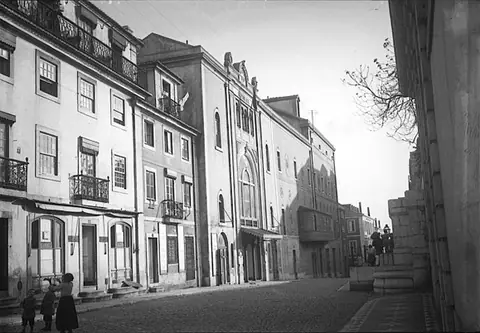
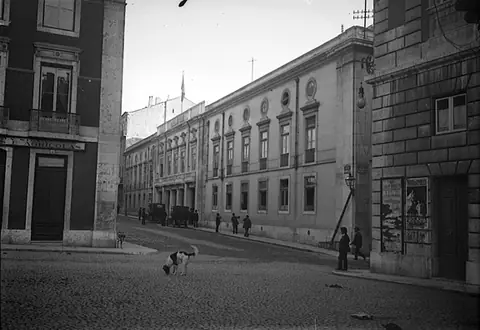
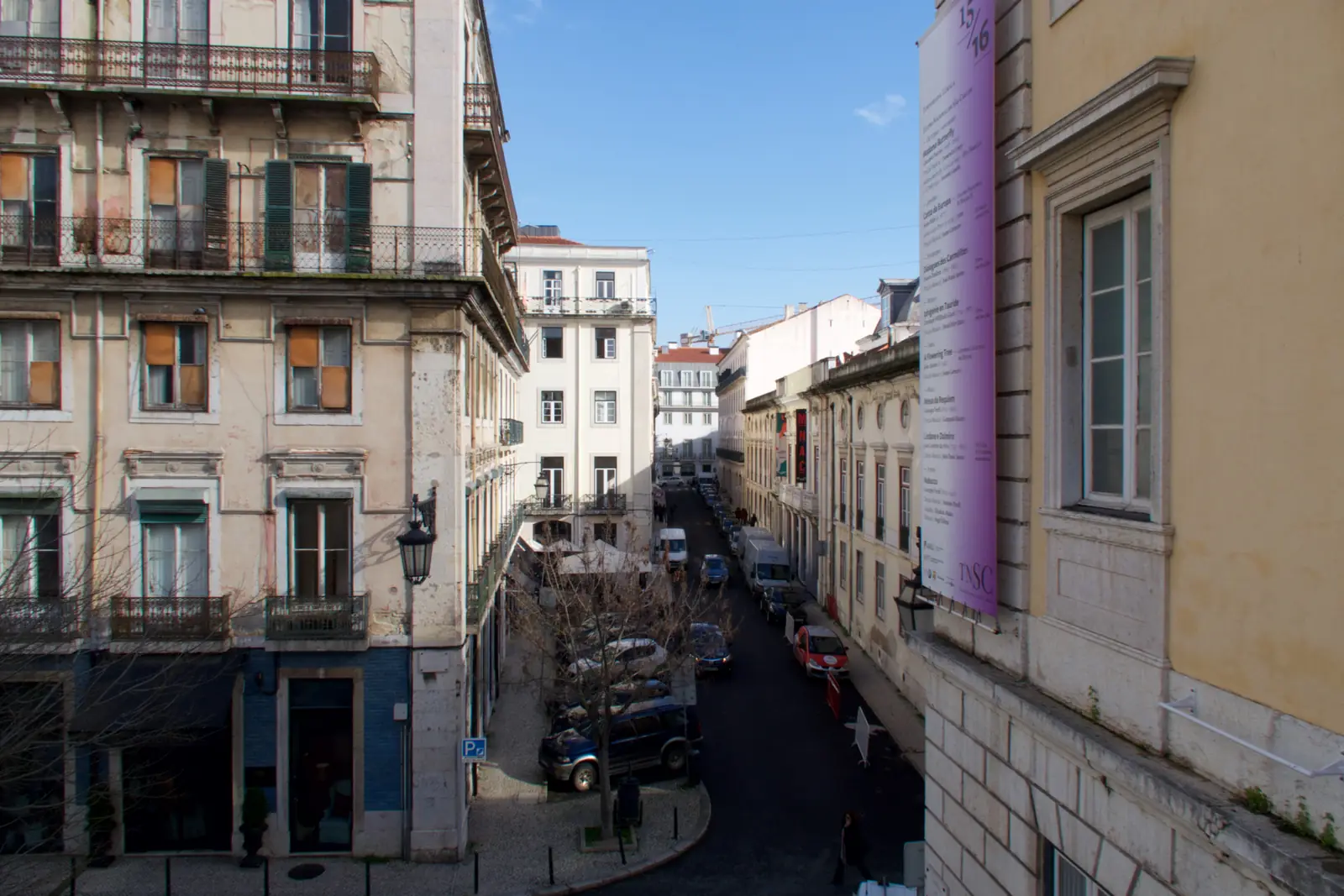
The façade of the São Luiz Theatre, on Rua António Maria Cardoso, in the Chiado, in March 2018.Hipersyl, CC BY-SA 4.0
Santa Maria Maior
São Luiz Theatre
On 24 February 1969, “Desfolhada Portuguesa” (Portuguese Husking), sung by Simone de Oliveira, won the Festival da Canção (Song Festival) here, with a line that the censors let through and that offended the most conservative morality. The theatre lived, as it says itself, “next door” to the headquarters of the political police.
Opened in 1894 as the Theatro D. Amélia, in honour of the queen, it was called the Teatro República from 1910 and the Teatro São Luiz from 1918; it burned down in 1914 and was rebuilt by 1916. Only in 1971 did it pass to Lisbon City Council.1 Under the dictatorship it lived, the theatre itself says, “next door to the headquarters of the political police” — the PIDE headquarters stood on this same street — and it was a place “where artists the regime kept under watch crossed paths with others who defended it”.2
On 24 February 1969, the Grande Prémio TV da Canção (TV Song Grand Prix) left the studios for the first time and was broadcast live from this stage, presented by the actress Maria de Lourdes Norberto. Of the ten songs in the competition, sung also by Teresa Paula Brito, Madalena Iglésias, Lilly Tchiumba and Maria da Fé, among others, the winner was “Desfolhada Portuguesa” (Portuguese Husking), a poem by José Carlos Ary dos Santos with music by Nuno Nazareth Fernandes, sung by Simone de Oliveira.345 The censors let through the line “Whoever makes a child, makes it for pleasure” (Quem faz um filho, fá-lo por gosto), which offended the most conservative morality; the singer was insulted in the street and came close to being arrested.56
In May 1974, with freedom already won, the Emissora Nacional and RTP organised a “free singing” show here: poems by Vinicius de Moraes, Alexandre O’Neill, Ary dos Santos, Manuel Alegre and Sophia de Mello Breyner Andresen were recited, and “Cantar Não É Talvez Suficiente” (Singing Is Perhaps Not Enough), by Manuel Alegre, with music by Francisco Fanhais, was sung.7 The theatre reopened in 2002, after a thorough refurbishment; in April 2022, the exhibition “48 Memórias” (48 Memories) showed the moments when its history crossed that of the regime.12
The day of the “free singing” show: RTP Arquivos dates the recording broadcast by the Emissora Nacional to 24 May 1974, without saying whether that is the day of the show or of the broadcast.
Do you know more, or do you have a document? Tell us.