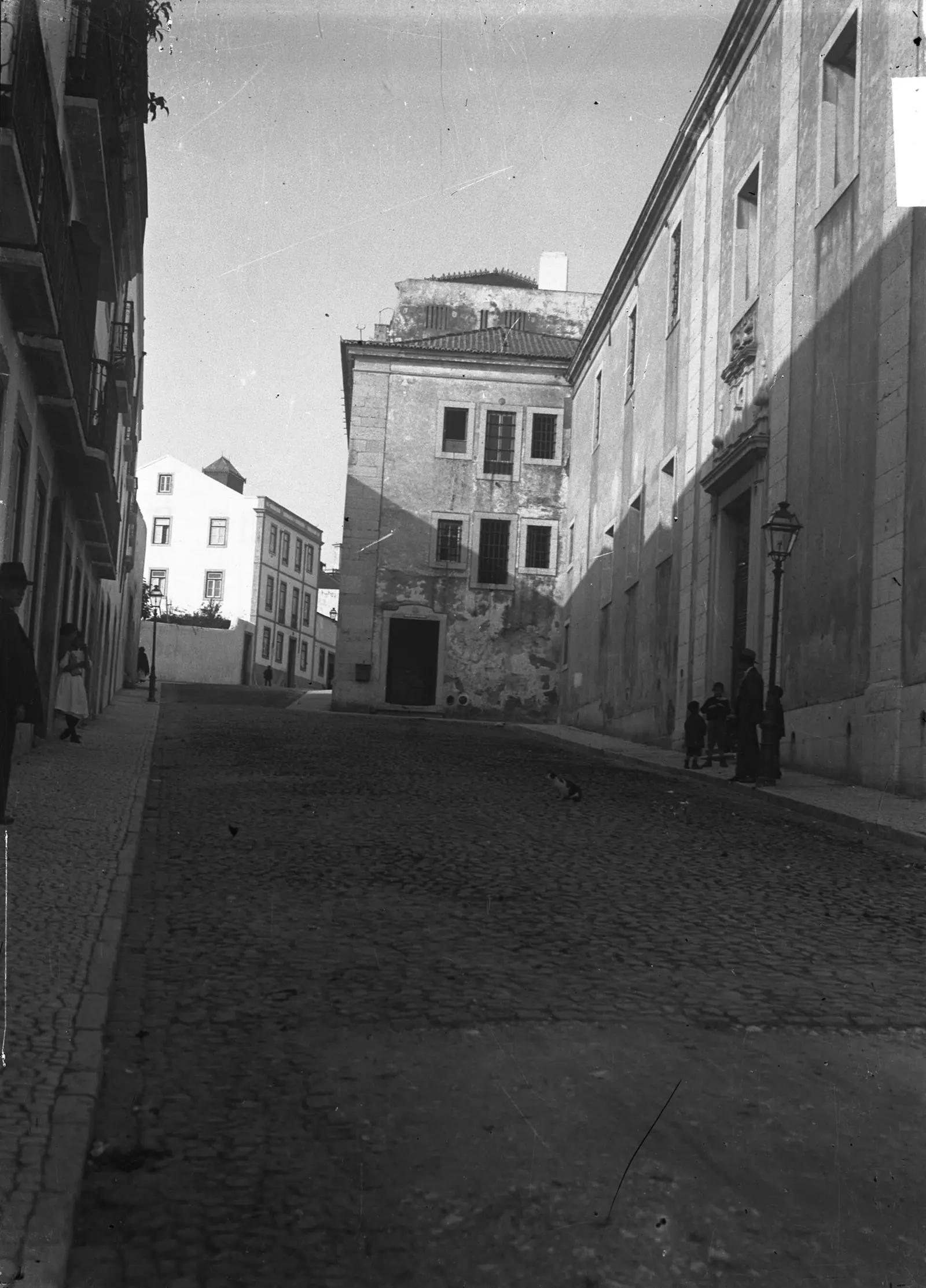
Travessa das Mónicas and the Mónicas Convent, already a prison, around 1900. Photograph by José Artur Leitão Bárcia (Lisbon Municipal Archive).José Artur Leitão Bárcia, Public domain
São Vicente
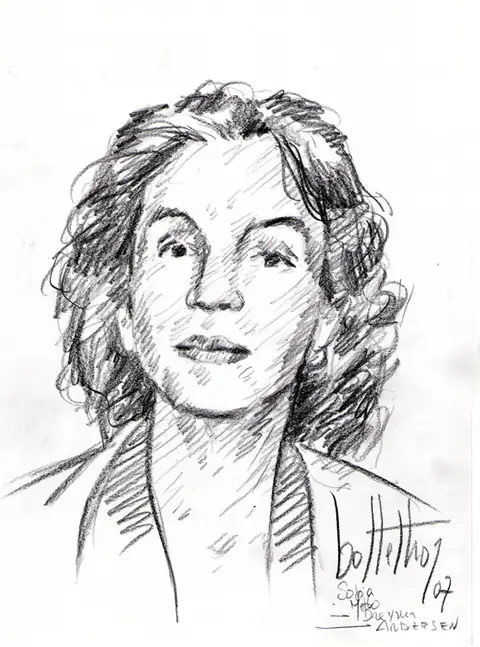
Home of Sophia de Mello Breyner Andresen
Sophia de Mello Breyner Andresen lived on the first floor of no. 57 from 1951 until her death in 2004. A home with its doors open to the opposition, with one side facing the river and the other the lane of the Mónicas women’s prison.
On 3 November 1951, Sophia de Mello Breyner Andresen, her husband, Francisco Sousa Tavares, and the three children they already had came to live on the first floor of no. 57 in this lane. That day, Sophia wrote to her mother: “I’m in Graça! I arrived today.”1 In an interview with José Carlos de Vasconcelos, she said that the garden “was a rubbish dump” when she arrived and that it was Gonçalo Ribeiro Telles who designed it; and that the house had “two sides”, one facing the Travessa das Mónicas, “where there was a prison” — the Mónicas Prison — and the other the river.1
“At Sophia’s house there were always guests. Everything was discussed there”, writes Luís Almeida d'Eça in the Agenda Cultural de Lisboa.2 In 1958, Sophia and her husband supported the campaign of Humberto Delgado, and Francisco Sousa Tavares was dismissed from the civil service.2 The architect Nuno Teotónio Pereira, who met her at the meetings of Catholics against the dictatorship, recalled that “there were meetings at her house” and that she took an active part.3
It was also at Sophia’s house, said the priest and singer Francisco Fanhais, that she and Rui Paz worked out the metre of the “Cantata da Paz” (Cantata of Peace) — “We see, we hear and we read / we cannot ignore” (Vemos, ouvimos e lemos / não podemos ignorar) — the poem she wrote for the São Domingos vigil, over the turn of 1968 into 1969. In a file in the Torre do Tombo archive, the researcher Eloísa Aragão found Sophia’s application to open a publishing house in this home, which the political police had suspended because it regarded her and her business partner as suspects.3 Sophia signed the Manifesto of the 101, against the colonial war and the Church’s support for Salazar, and was among the women who founded the National Commission for Aid to Political Prisoners.43
She died in Lisbon on 2 July 2004, and ten years later her remains were moved to the National Pantheon. Near here, the old Graça viewpoint was named after her in 2009, on the fifth anniversary of her death, with a bust — a replica of a bronze sculpted in the 1950s by António Duarte — and a plaque with the poem “Lisboa” (Lisbon), from Navegações (Navigations). The Agenda Cultural de Lisboa suggests an itinerary through six places in Graça in memory of the poet.25
In July 2009, Lisbon City Council gave Sophia’s name to the former Graça viewpoint, near the house where she lived for more than half a century, and paid tribute to her there. The report records the unveiling of the bust, a replica of the one sculpted by António Duarte, the unveiling of the street-name plaque and the placing of the poem “Lisboa” in the square of the Graça Church.
Original page Licença padrão do YouTube — embed permitido pelo canal oficial da Câmara Municipal de Lisboa
Câmara Municipal de Lisboa, on YouTube. The player only connects to that site when you press “Watch”.
Notes on the sources3
O ponto no mapa: o OpenStreetMap só identifica o n.º 57-D da mesma travessa; falta confirmar a porta do n.º 57.
Se há alguma placa na fachada do n.º 57.
A data do pedido para abrir uma editora nesta casa e o processo da Torre do Tombo onde está.
Do you know more, or do you have a document? Tell us.