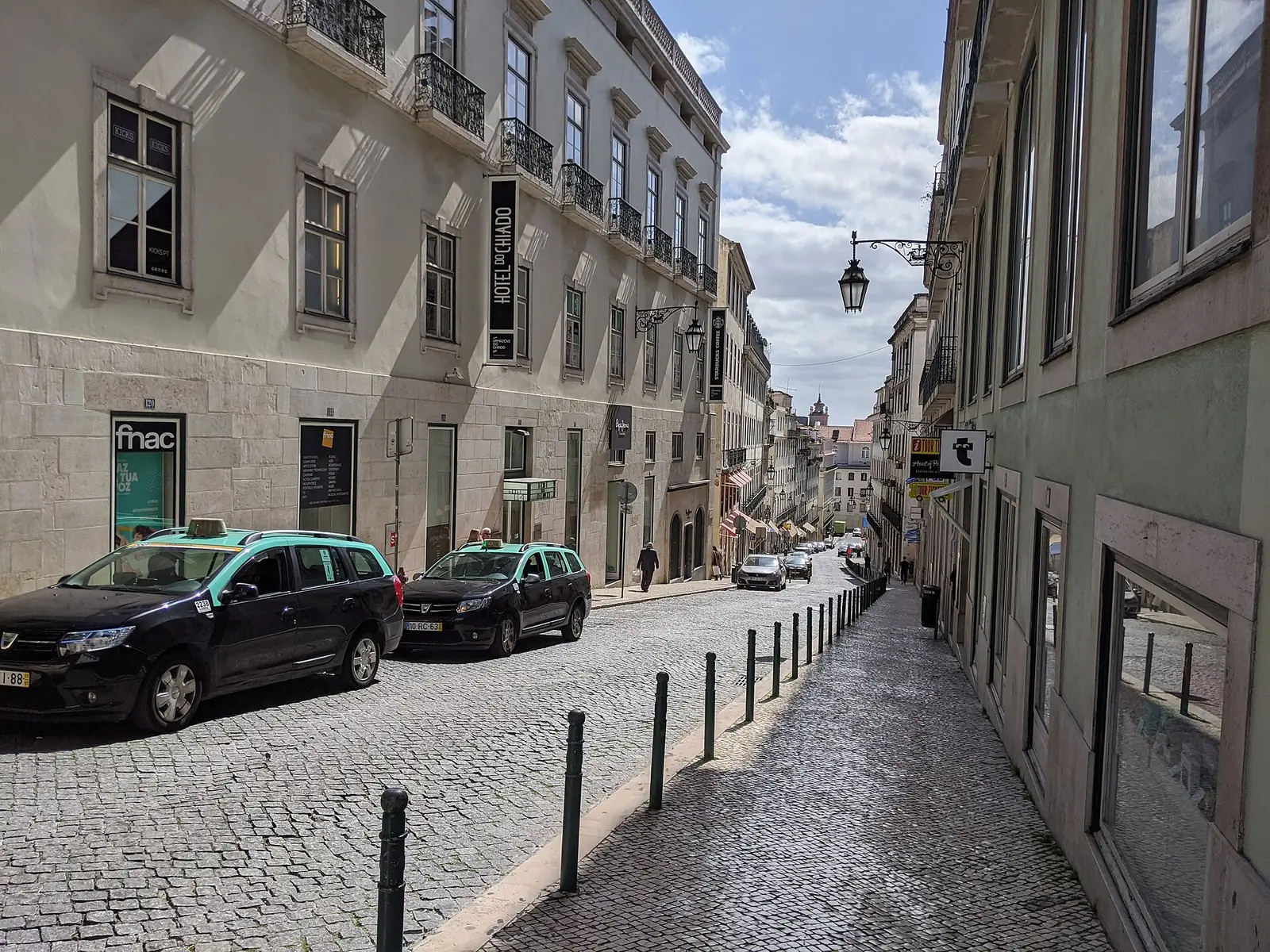
Rua do Carmo, climbing towards the Chiado, with the walkway of the Elevador de Santa Justa in the background, in 2019.Jan Helebrant, CC0 1.0
Santa Maria Maior
Rua do Carmo — Celeste Caeiro’s carnations
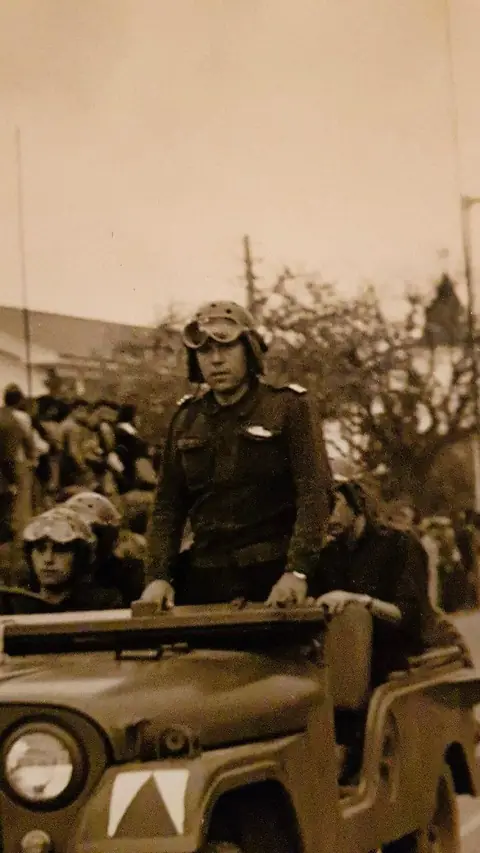
Salgueiro Maia’s column climbed this street, from the Rossio to Largo do Carmo. It was here, at the start of the street, by the Rossio — according to the “Diário de Notícias” and the plaque put up in 2025 — that Celeste Caeiro gave a carnation to a soldier who asked her for a cigarette, and the carnation became the symbol of the revolution.
Today: Rua do CarmoThere is a marker at the siteApproximate location
At around midday on 25 April, the armoured vehicles of the Cavalry Practical School left the Terreiro do Paço for Largo do Carmo. In the Rossio, a company sent to stop them placed itself under the Movement’s orders; then the vehicles struggled up the steep streets, cheered by thousands of people, and reached the Carmo at about 12:30.2
Celeste Caeiro worked at the Sir restaurant, in the Franjinhas Building, on Rua Braamcamp. The restaurant turned one year old that day and the owners had bought carnations to give to the women customers; with the coup under way it did not open, and the carnations were given to the women on the staff.7 Celeste came down to the Baixa with her bunch of flowers. By the Chaimite armoured cars, a soldier said to her: “We’re going to the Carmo to arrest Marcelo. By the way, miss, you wouldn’t have a cigarette on you?” (Vamos para o Carmo prender o Marcelo. Já agora, a menina não tem aí um cigarrinho?) She did not smoke. She gave him a carnation, and he put it in the barrel of his rifle. She later said she must have given away about six.5
The gesture was repeated across the city, and the foreign newspapers called it the Carnation Revolution. Celeste Caeiro took part in the parade down Avenida da Liberdade for the 50th anniversary of 25 April, in 2024, in a wheelchair, with carnations in her hand. She died on 15 November that year.8
The unveiling, at the end of Rua do Carmo, by the Rossio, of a plaque bearing the poem “Celeste em Flor” (Celeste in Bloom), by Rosa Guerreiro Dias, which recalls the carnation Celeste Caeiro gave to a soldier who had asked her for a cigarette. The plaque marks the gesture 51 years on.
Original page Licença padrão do YouTube — embed permitido pelo canal oficial da Câmara Municipal de Lisboa
Câmara Municipal de Lisboa, on YouTube. The player only connects to that site when you press “Watch”.
Celeste Caeiro, then aged 80, tells in her own words the story of the carnations that became the symbol of 25 April, in a video published by Lisbon City Council on the eve of the revolution’s 40th anniversary.
Original page Licença padrão do YouTube — embed permitido pelo canal oficial da Câmara Municipal de Lisboa
Câmara Municipal de Lisboa, on YouTube. The player only connects to that site when you press “Watch”.
Notes on the sources3
The exact spot of Celeste Caeiro’s gesture: “the start of Rua do Carmo” (“Diário de Notícias”), the corner with Rua Garrett (“A Mensagem de Lisboa”), “in front of the Tabacaria Caravela” (“Diário de Notícias”) or the Rossio (English Wikipedia). The coordinate is that of the street.
Whether Celeste was going home (she lived in the Chiado) or to the Rossio by metro: the published accounts differ.
The time of the encounter: the sources say only that it was in the morning or near midday.
Do you know more, or do you have a document? Tell us.
10Celeste Caeiro. Wikipédia (português) — consulted on 2 October 2026
11Celeste Caeiro. Wikipédia (inglês) — consulted on 2 October 2026
12«Celeste dos Cravos» imortalizada na Rua do Carmo. Região de Lisboa (SAPO), abril de 2025 — consulted on 3 October 2026A placa com o poema «Celeste em Flor», de Rosa Guerreiro Dias, foi descerrada pela Câmara de Lisboa a 25 de abril de 2025, no fim da Rua do Carmo, junto ao Rossio.
Coordinates: OpenStreetMap (Nominatim), consultado a 2 de outubro de 2026.



.jpg)