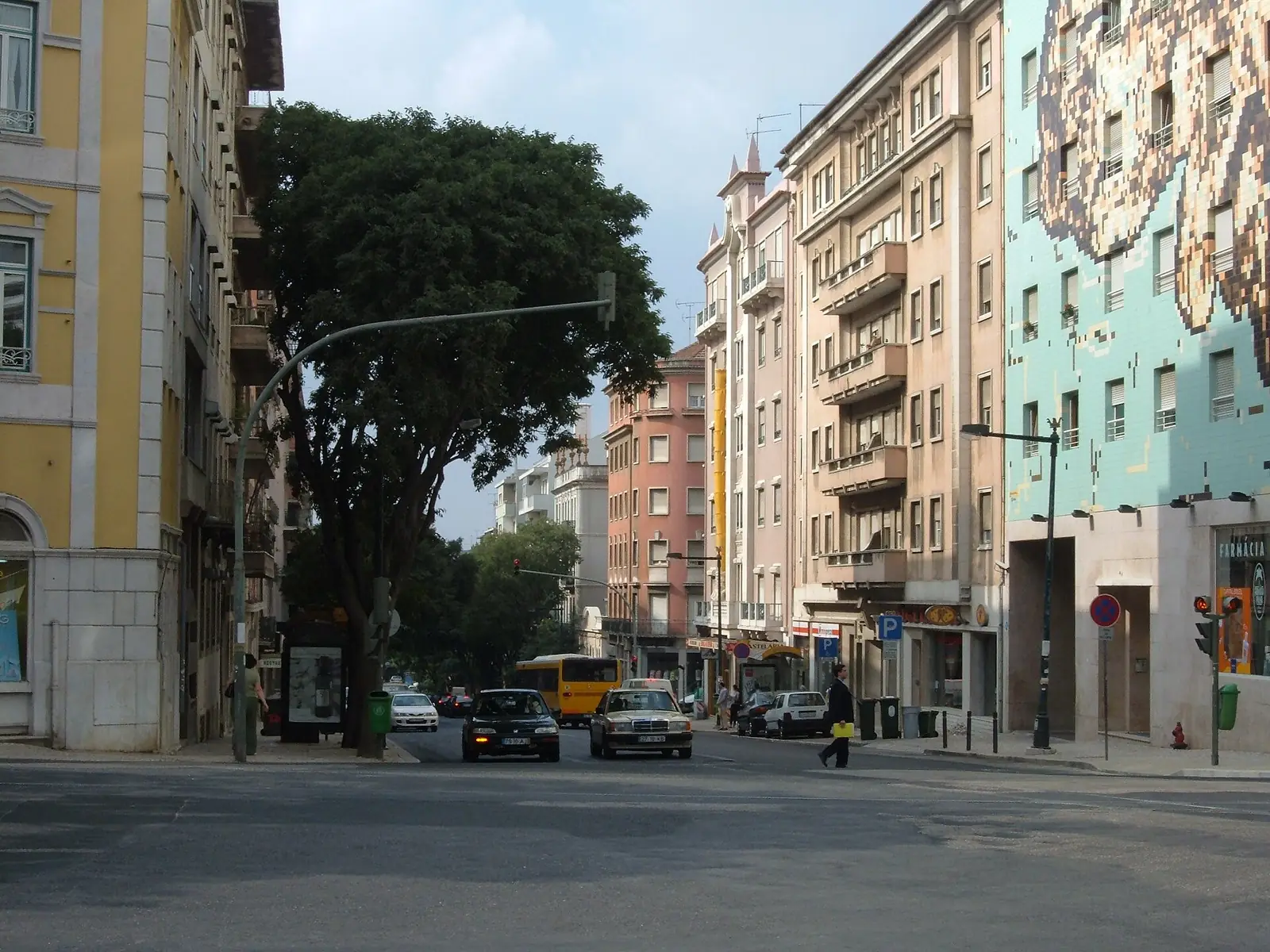
Alameda D. Afonso Henriques seen from above, with the Instituto Superior Técnico in the background, in August 2025.Alexkom000, CC BY 4.0
Arroios
Instituto Superior Técnico
Pardal Monteiro’s campus was the scene of decisive plenary meetings of the student movement: here the academic mourning of 1962 was suspended, here the PIDE raided the students’ association in 1968, and here it was decided, in 1972, to go en masse to Ribeiro Santos’s funeral.
Today: Instituto Superior Técnico – University of Lisbon
The Alameda campus, designed by Porfírio Pardal Monteiro (the project dates from 1928), was born under the aegis of Duarte Pacheco, on the Arco do Cego land, and was completed between 1936 and 1937.8 In 1953, Maria de Lourdes Pintasilgo graduated here in Industrial Chemical Engineering: of the 250 students on her course, only three were women.9
In the academic crisis of 1962, with the exam season looming, a plenary meeting at the Técnico voted by a majority, on 14 June, to suspend the academic mourning. Some students were unhappy, but the associations abided by the decision; the protest went on over the imprisonment of the student leaders, above all Eurico Figueiredo, and over the disciplinary proceedings.1 The date is that of communiqué no. 43 of the Students’ Associations, of 14 June 1962, written for the “Plenary being held today”, to which the leaders were going to propose “a change of direction” and the end of the mourning; the Commemorative Commission for the 50th Anniversary gives 15 June.2
Under the influence of May ’68 and with the growing rejection of the colonial war, student mobilisation grew again. On 8 December 1968, the PIDE raided the Técnico Students’ Association, seized documents and identified students. The association and the Institute were closed until the end of the holidays, the association’s board was suspended and several students faced disciplinary proceedings.4 There followed the police invasion of the Cidade Universitária, a form of intimidation that would become recurrent.3
On the night of 12 October 1972, hours after José António Ribeiro Santos had been shot dead by a PIDE/DGS agent at the ISCEF, 300 students meeting at the Técnico voted to bring the university to a standstill and to go to the funeral en masse.56 That year, the IST was again invaded by riot police and closed.4
On 15 May 1977, the Democratic Women’s Movement (MDM) held its 3rd National Meeting here, under the slogan “The Strength of being a Movement, the Reason for being Democratic and the Joy of being a Woman” (A Força de ser Movimento, a Razão de ser Democrático e a Alegria de ser Mulher). Two thousand women, in five working groups, approved the first Charter of Women’s Rights.10
The history of these struggles is told in the book O activismo estudantil no IST (1945-1980) (Student Activism at the IST, 1945–1980), edited by Luísa Tiago de Oliveira and presented at the Aljube Museum in November 2019.4
Helena Rato, born in 1944, grew up in a house that gave support to the Secretariat of the clandestine Portuguese Communist Party (PCP); she was studying at the Instituto Superior Técnico when, during the 1962 academic crisis, she took part in the Inter-Associations Meeting and joined the party’s secretariat at the Técnico. In the testimony published by the Aljube Museum in 2024, she also talks about going underground, in 1963, and about exile, from Paris and Algiers to Brussels.
Original page Licença padrão do YouTube — embed permitido pelo canal oficial do Museu do Aljube
Museu do Aljube Resistência e Liberdade, on YouTube. The player only connects to that site when you press “Watch”.
Albano Nunes entered politics through the 1962 academic crisis and was elected, in 1962–1963, to the board of the Students’ Association of the Instituto Superior Técnico; he then became secretary-general of the Inter-Associations Meetings and was eventually expelled from the University of Lisbon. In the testimony the Aljube Museum published in 2023, he also tells how he came to be a full-time official of the Portuguese Communist Party (PCP), in 1965.
Original page Licença padrão do YouTube — embed permitido pelo canal oficial do Museu do Aljube
Museu do Aljube Resistência e Liberdade, on YouTube. The player only connects to that site when you press “Watch”.
Notes on the sources1
When, and for how long, the IST was closed in 1972.
Do you know more, or do you have a document? Tell us.
2Associações de Estudantes, Comunicado n.º 43 das Associações de Estudantes (Lisboa, 14 de junho de 1962). Casa Comum — Fundação Mário Soares e Maria Barroso (fundo Ângelo Sajara, pasta 04928.035), 1962 — consulted on 4 October 2026Datado de 14 de junho de 1962; os dirigentes associativos explicam a posição que vão levar «ao Plenário que hoje se realiza» — uma mudança de orientação, com a possível cessação do luto académico.